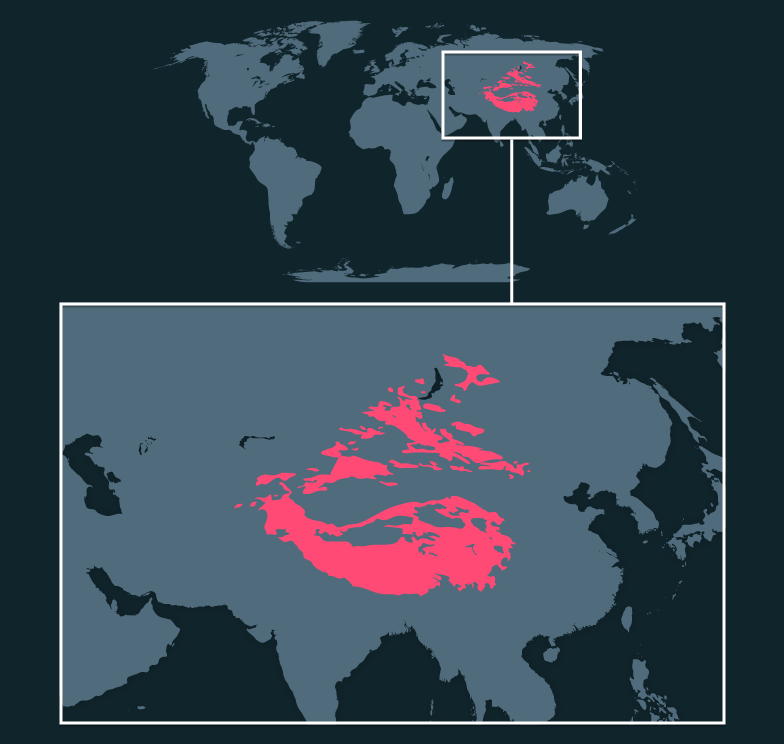
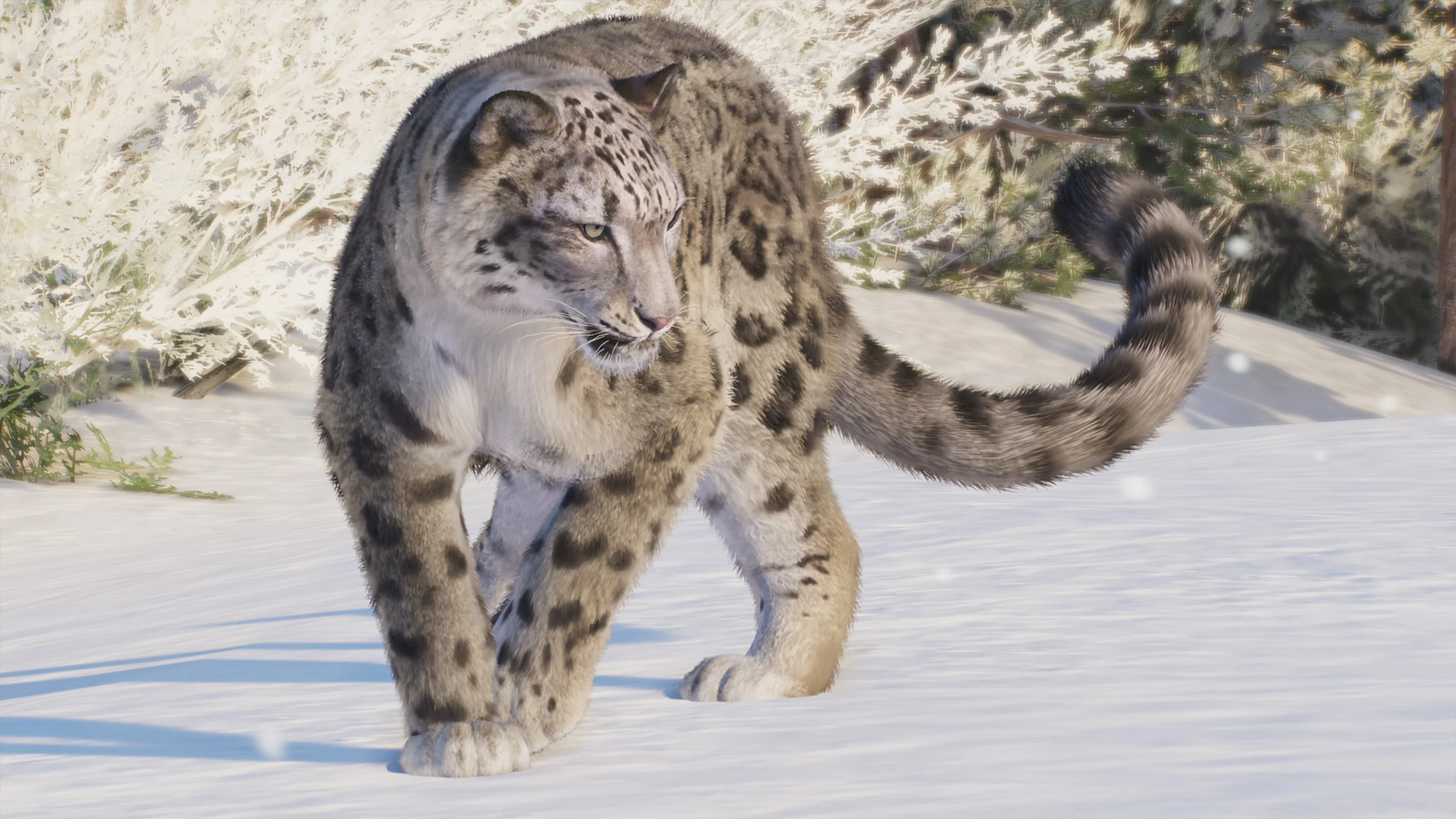
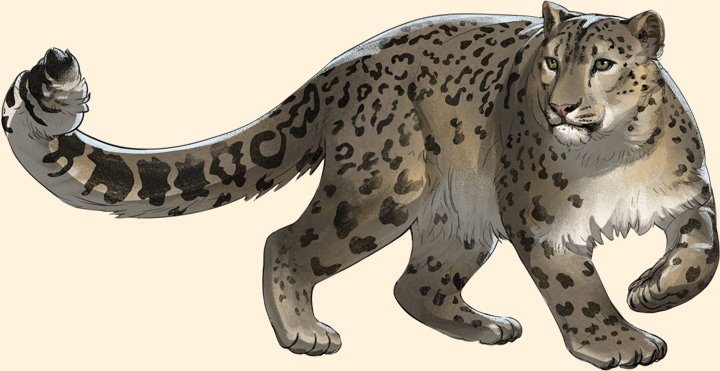
The snow leopard (or Panthera uncia), identifiable by its white to grey fur, black rosettes across its body, and black spots on its face, lives in the mountains of Nepal, Tibet, Northern India, Southern Siberia, Pakistan, Bhutan and Mongolia.
The animal's fur is extremely thick and well insulated, which helps it comfortably withstand sub-zero temperatures as low as -25°C. They mostly feed on mountain goats and sheep, but also hunt birds and rodents.
The species is less sexually dimorphic than other big cats, but males are still slightly larger than females on average. Head-body length ranges from 0.75m to 1.5m, with 0.8m to 1.05m added by the long tail. Shoulder height is around 56cm tall. Males weigh an average of 45kg to 55kg, females are lighter at 35kg to 40kg.
Snow leopards are solitary animals and live alone, unless it is a mother with her cubs. They have home ranges, but are not aggressively territorial over them and will tolerate other leopards moving through their space.
Enrichments
Food-Based Enrichments
Bamboo Feeder
Frozen Blood Pumpkin
Piñata Zebra
Piñata Pronghorn
Rotation Line Feeder
Habitat Enrichments
Prey-scented sack
Rubbing Pad
Scratching Post
Rubbing Pad Bark
Small Ball
Ice block
Firehose ball
Conservation Topics
Mountain Ecosystem Ambience
Crepuscular Behavior
Carnivore Diet
Mammal Evolution
Snow Leopard Fact Sheet
Jumping Animals
The Animal Kingdom Talk
Genetic Bottlenecks
Poaching and the Exotic Pet Trade
Human-Wildlife Conflict
Climate Change
Snow Leopard Name Plate
Lifecycle
Snow leopards are solitary animals and live alone, unless it is a mother with her cubs. They have home ranges, but are not aggressively territorial over them and will tolerate other leopards moving through their space.
During the mating season from December to March, snow leopards scent-mark and call in order to signal to mates. When a male and female snow leopard meet, they will mate multiple times over several days. They only mate with one partner each breeding season.
Female snow leopards are pregnant for 3 months and then give birth to 1 to 3 cubs in a den in a rock crevice. Cubs are born with thick fur to survive the harsh temperatures, begin walking at 5 weeks old and are already weaned by 10 weeks old. The young follow their mothers out of the den at 2 to 4 months old, and remain with them until they are almost 2 years old.
At 20 to 23 months old, they gradually begin distancing themselves from their mothers and eventually leave her territory to establish their own. Sexual maturity is reached at 3 years.
Statistics
Litter Size
1-3
Gestation / Incubation Period
3 months
Interbirth Period
21 months
Reproduction Difficulty
Easy
Age Of Sexual Sterility
20 years
Age Of Sexual Maturity
3 years
Juvenile3 years
Adult17 years
Elderly5 years
Animal Facts
Snow leopards have very large paws in proportion to their body size that allow them to move quickly and stealthily along the snow.
The snow leopard can jump higher and further than any other cat species; reaching heights of 6m when jumping and distances of 15m when pouncing.
Snow leopards can live at altitudes of 5400m.
Snow leopards are 'crepuscular' animals; they are active at dawn and dusk.
It is theorized that snow leopards will often hold their own tail in their mouth to use it as a muffler against the wind and snow.
Conservation
As a Vulnerable species, snow leopards face many conservation challenges that threaten their survival across the mountain ranges of Central and South Asia. Infrastructure, agricultural, and mining operations fragment their habitat, making it harder for them to find prey and access new mates and thereby maintain healthy genetic diversity. Poaching for body parts and retaliatory killings further adds pressure. Climate change compounds these challenges by shrinking suitable high-altitude terrain and altering prey distributions as well as increasing competition with other predators.
International and local organizations collaborate with governments and mountain communities to reduce human-wildlife conflict, support anti-poaching patrols and improve habitat protection. Livestock insurance schemes, predator-proof fencing and other economic incentives reduce the causes for retaliatory killings and illegal trade. In some regions, populations surveys and local engagement have shown promising signs of stabilizing population numbers. The snow leopard is listed under CITES I, restricting most trade, but illegal trade for cultural dress and traditional medicine remains a problem across many countries.
Native Range
Central Asia
Statistics
Wild Population
3,900 - 6,500 (estimated)
Conservation Status
Vulnerable
Valid Release Group Types
Female Bachelor Herd
Solitary Male
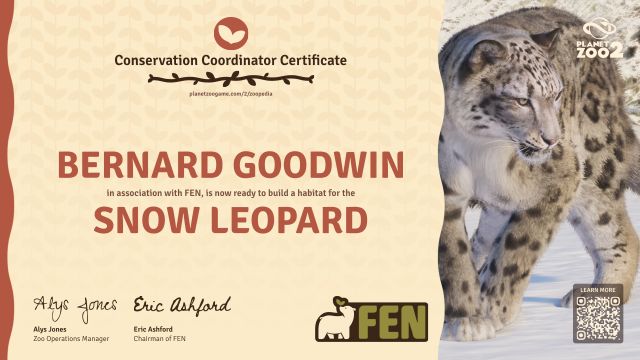
Are you ready to run a zoo?
Prove your knowledge and create a personalised certificate endorsed by the Fauna & Ecosystems Network for the Snow Leopard.
Planet Zoo 2 is in active development and the Zoopedia reflects this work in progress. Text, images, stats etc. are not necessarily final and may change or be expanded upon.



 Bamboo Feeder
 Frozen Blood Pumpkin
 Piñata Zebra
 Piñata Pronghorn
 Rotation Line Feeder
 Prey-scented sack
 Rubbing Pad
 Scratching Post
 Rubbing Pad Bark
 Small Ball
 Ice block
 Firehose ball