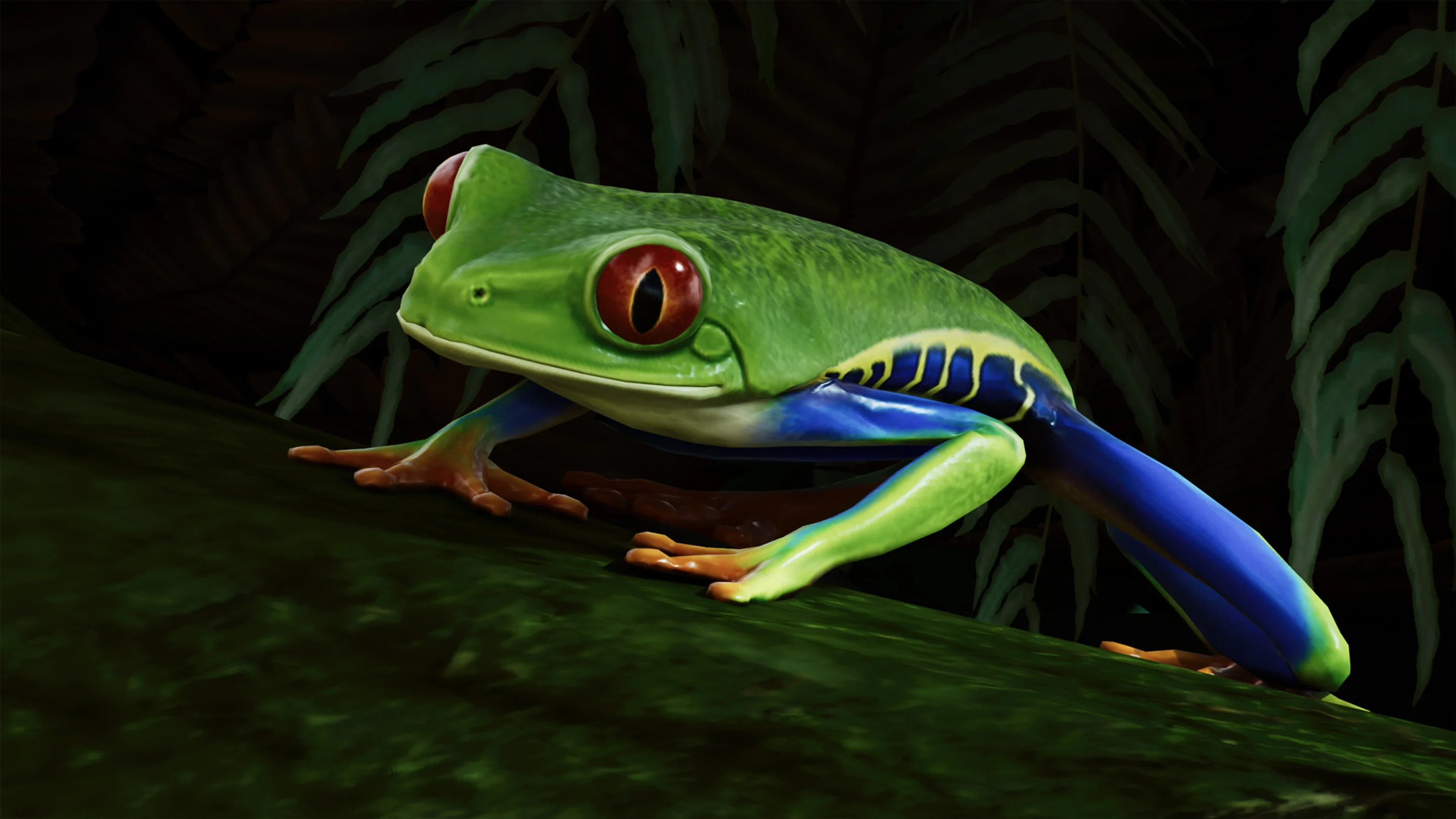
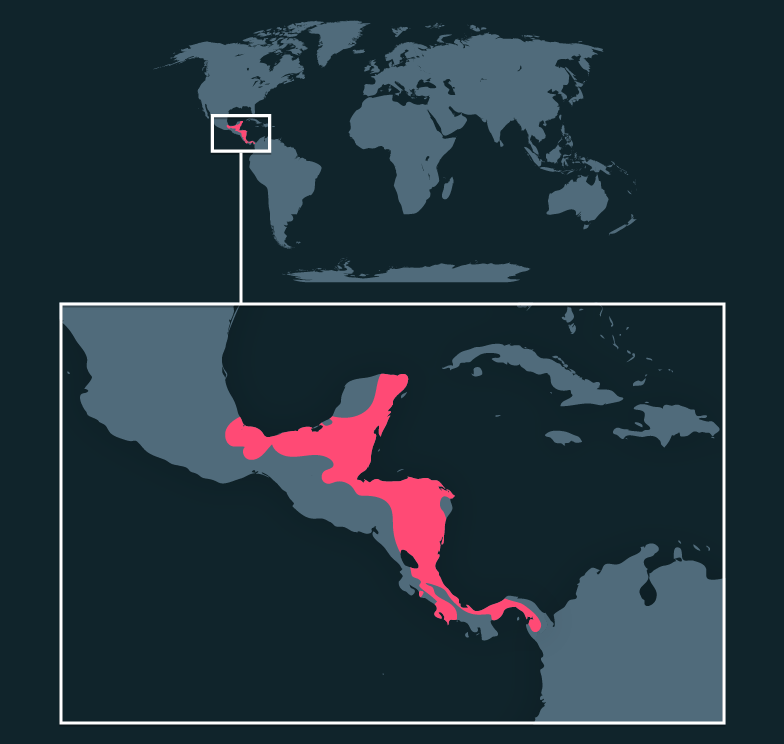
The red-eyed tree frog (or Agalychnis callidryas) is a species of arboreal amphibian that lives in the tropical rainforest regions of Central America.
As the name suggests, the red-eyed tree frog has vivid red eyes with black pupils. The upper body and upper legs of the frog are pale green. The sides are bright blue with yellow reticulation and blue thighs, orange feet and a pale underbelly. As such, when the frog curls up and closes its eyes it is well camouflaged against the leaves on which it lives.
Female frogs are larger than males, at an average of 7.5cm body length compared to 5cm, but otherwise look alike.
The red-eyed tree frog is a solitary animal but may live close to other frogs. Red-eyed tree frogs only interact in the mating season to mate or compete for mates.
Enrichments
Conservation Topics
Rainforest Ecosystem Ambience
Nocturnal Behavior
Amphibian Extinction Crisis
Insectivore Diet
Amphibian Evolution
Red-Eyed Tree Frog Fact Sheet
Herpetology Talk
Poaching and the Exotic Pet Trade
Deforestation
Red-Eyed Tree Frog Name Plate
Lifecycle
The red-eyed tree frog is a solitary animal but may live close to other frogs. Red-eyed tree frogs only interact in the mating season to mate or compete for mates.
During the rainy season, male frogs will attempt to attract females and intimidate rival males by vocalizing and shaking the leaves in their territory. Larger males are able to make louder noises, and are more likely to mate successfully due to females selecting their mates based on the volume of calls. The male she mates with will remain on her back until she lays her eggs.
The female will move around with the male on top of her until she finds a suitable area to lay her eggs, preferably a leaf that is above a pool of water. The male will fertilize the eggs as she lays them. Eggs hatch 6 to 10 days after laying, and tadpoles will fall into or nearby the water below. The eggs contain a lot of fluid so that when they hatch, the tadpoles have a better chance of being washed into water. Tadpoles take 40 to 60 days to develop into froglets. Froglets spend the time after emerging from the water hiding in flowers and eating fruit flies until they get larger.
It will take them around 10 months to 1 year to reach full size and 1 to 2 years to reach sexual maturity. Young male frogs are less likely to mate than older male frogs due to their smaller size.
Statistics
Gestation / Incubation Period
0 months
Interbirth Period
11 months
Reproduction Difficulty
Easy
Age Of Sexual Sterility
death
Age Of Sexual Maturity
1 years
Adult4 years
Elderly5 years
Animal Facts
It is believed that the red eyes of this frog evolved as a startle display; the frog is well camouflaged with eyes closed, but if under threat it can open its eyes to shock a potential predator.
Red-eyed tree frogs have extremely sticky feet due to their surface being made up of an uneven microscopic hexagon pattern. This allows them to crawl upside down and stick to most surfaces, even when carrying the weight of another frog.
Red-eyed tree frog eggs can detect vibrations from nearby predators and may hatch early to escape harm.
Despite their bright coloration that may be perceived as a warning to predators, red-eyed tree frogs are not poisonous.
Red-eyed tree frog tadpoles can survive for up to 20 hours out of water.
Conservation
The red-eyed tree frog is of Least Concern, although its population is threatened by deforestation and unsustainable collection for the pet trade. The natural rainforest habitat of red-eyes tree frogs in Central America is in decline due to logging, agricultural land conversion, and urban expansion. They are sought after in the pet trade due to their striking coloration, and some populations in Costa Rica, Nicaragua and Panama are especially at risk from capture.
Many areas in which red-eyed tree frogs live are already part of protected areas, and it is under protection from the illegal wildlife trade under CITES Appendix II, which controls international trade of animals by requiring a permit to be authored before export is allowed. Red-eyed tree frogs appear to be relatively tolerant of habitat fragmentation, but nonetheless, care must be taken to protect their remaining habitat to manage their ongoing population decline.
Native Range
South America, North America
Statistics
Wild Population
Unknown
Conservation Status
Least Concern
Are you ready to run a zoo?
Prove your knowledge and create a personalised certificate endorsed by the Fauna & Ecosystems Network for the Red-Eyed Tree Frog.
Planet Zoo 2 is in active development and the Zoopedia reflects this work in progress. Text, images, stats etc. are not necessarily final and may change or be expanded upon.