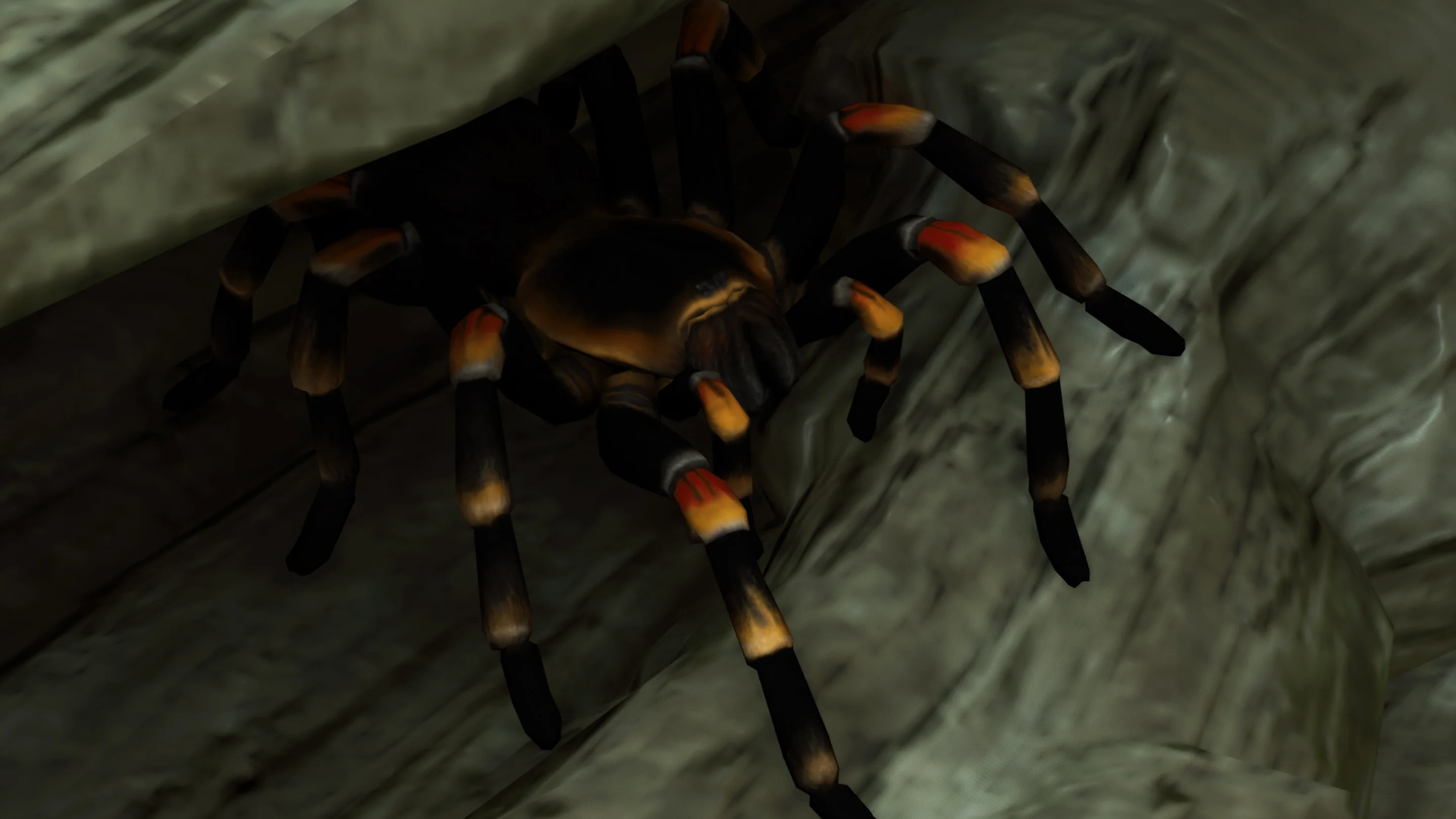
The Mexican redknee (or Brachypelma hamorii) is a species of tarantula that lives in the scrublands, deserts and forests of Mexico.
It has a black body and legs, orange-red coloration on the joints and, like most tarantula species, a body that is covered in sensitive hairs. They are nocturnal, living in burrows during the day and spending their nights hunting for prey, comprised of insects, small amphibians and small mammals.
Mexican redknees measure around 10cm long with a leg span of 15cm. Females have slightly larger bodies, but shorter legs than males.
Mexican redknees are solitary animals and are likely to be aggressive towards each other if kept together in a terrarium.
Enrichments
Conservation Topics
Forest Ecosystem Ambience
Nocturnal Behavior
Carnivore Diet
Arachnid Evolution
Mexican Redknee Tarantula Fact Sheet
The Arthropod World Talk
Habitat Loss
Population Fragmentation
Poaching and the Exotic Pet Trade
Mexican Redknee Tarantula Name Plate
Lifecycle
Mexican redknees are solitary animals and are likely to be aggressive towards each other if kept together in a terrarium.
Mexican redknees mate from July to October. The male spins a web on the ground onto which he deposits sperm, then absorbing it onto his palps (mouth appendages). After going in search of a female's burrow, he will attempt to coax her out, approaching her and using his front legs to hook back her fangs to deposit the sperm from his palps into a furrow on her abdomen.
The female will store it until she is ready to lay between 200 and 400 eggs in an egg sac. She guards this in her burrow for 1 to 3 months, carrying it with her when she leaves, until the spiderlings hatch. They are protected by their mother in the burrow until their first molt at approximately 2 weeks old, after which they will venture out and become independent.
Mexican redknee males reach sexual maturity at about 4 years old, while females mature a little later at 6 or 7 years old.
Statistics
Litter Size
1-3
Gestation / Incubation Period
2 months
Interbirth Period
10 months
Reproduction Difficulty
Easy
Age Of Sexual Sterility
Death
Age Of Sexual Maturity
5 years
Juvenile5 years
Adult25 years
Elderly0 years
Animal Facts
Mexican redknees do not need to eat often. After a large meal they may not hunt again for another month.
The Mexican redknee has two small 'claws' on the end of each of its legs that allow it to climb smooth surfaces.
The Mexican redknee uses its legs to pick up tiny vibrations in the ground when hunting and ambushing prey.
The end of the Mexican redknee's legs are able to sense smell and taste, as well as touch.
The venom of the Mexican redknee is not strong to humans, and the bite is said to be equivalent to a bee sting.
Conservation
The Mexican redknee is assessed as a Vulnerable species, primarily threatened by habitat loss due to urban and agricultural expansion and the associated infrastructure. High habitat fragmentation means males must move a lot to find mates, and are at high risk of vehicle collision when trying to cross roads. Additionally, the Mexican redknee is often illegally collected for the pet trade.
International trade of Mexican redknees is controlled by CITES Appendix II, however, enforcement remains a problem. Increased captive breeding could help meet demand in the pet trade, and affected wild populations may benefit from translocations to return them to a healthy level. Some parts of this tarantula’s range are already covered by national parks and reserves, but further regions have been flagged as high priority for the establishment of protected areas.
Native Range
North America
Statistics
Wild Population
Unknown
Conservation Status
Vulnerable
Are you ready to run a zoo?
Prove your knowledge and create a personalised certificate endorsed by the Fauna & Ecosystems Network for the Mexican Redknee.
Planet Zoo 2 is in active development and the Zoopedia reflects this work in progress. Text, images, stats etc. are not necessarily final and may change or be expanded upon.