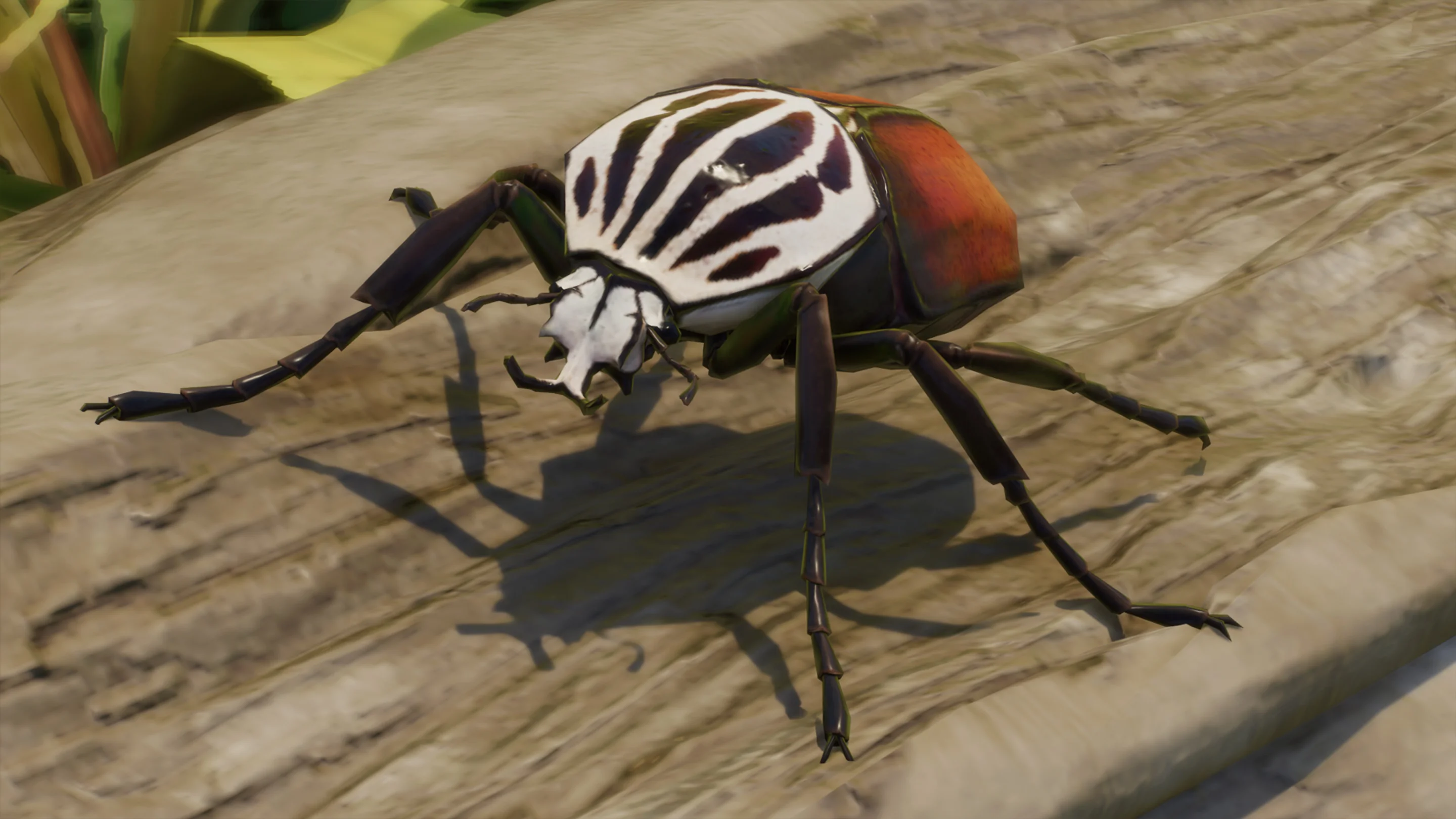
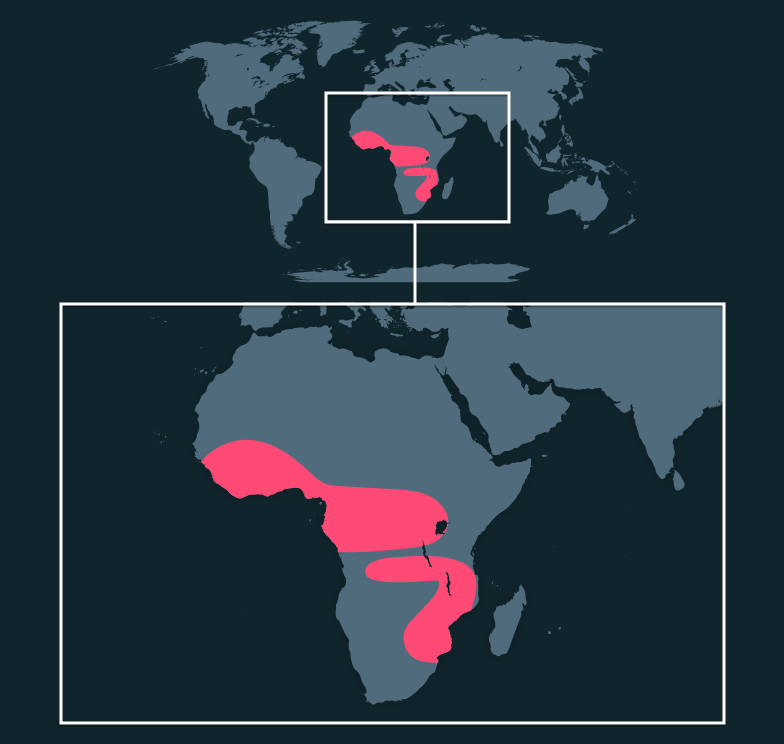
The Goliath beetle (or Goliathus goliatus) is a large species of insect that lives in the savannah and rainforests of Central Africa. The males and females are different in appearance and size:
The males are larger - between 60mm and 100mm - with a dark brown abdomen, a brown thorax with white stripes, black legs, as well as a white head with a Y-shaped horn. The females have shorter, thinner stripes on the thorax, are smaller in size - between 50mm and 80mm - and do not have a horn.
Goliath beetles are solitary animals – other than to mate or compete over mates, they do not interact in the wild.
Enrichments
Conservation Topics
Savannah Ecosystem Ambience
Diurnal Behavior
Omnivore Diet
Insect Evolution
Goliath Beetle Fact Sheet
The Arthropod World Talk
Deforestation
Habitat Loss
Goliath Beetle Name Plate
Lifecycle
Goliath beetles are solitary animals – other than to mate or compete over mates, they do not interact in the wild.
At the end of the rainy season, males track females via her pheromones. Males are territorial; they will fight any other males off with their horns and mate with any females passing through. After mating, the female goliath beetle will dig a shallow hole in sandy soil and lay her eggs inside.
The eggs hatch into larvae between 12 to 14 days later. The larvae will forage on decaying plant and animal matter on the forest floor until they reach approximately 100g in weight; at this point they will bury themselves in the ground and pupate, remaining there for 5 months, hatching after the rainy season has made the ground moist.
It takes approximately 1 year for an egg to become an adult, and these fully-grown beetles emerge to begin to search for mates.
Statistics
Gestation / Incubation Period
0 months
Interbirth Period
11 months
Reproduction Difficulty
Easy
Age Of Sexual Sterility
death
Age Of Sexual Maturity
1 years
Adult0.75 years
Elderly2.5 years
Animal Facts
Goliath beetles are part of the scarab beetle family.
The Goliath beetle can reach record lengths of 110mm.
The Goliath beetle uses its tarsi (feet claws) to scratch at the bark of trees and extract sap.
The larvae of the Goliath beetle require a high protein diet to achieve their large size as adults, so it is very important where a female chooses to lay her eggs.
Goliath beetles have a short lifespan as adults; when they emerge from their pupa, they begin searching for a mate and will die soon after mating.
Conservation
The conservation status of goliath beetles has not been evaluated, though it has been suggested to list them as Near Threatened. The population is in decline in some regions due to habitat loss from deforestation. As one of the largest beetles in the world, wild specimens are often taken for the international insect trade, and experiences considerable collection pressure in some of its range.
While there currently are no conservation projects aimed at goliath beetles, they passively benefit from the establishment of several national parks or reserves across their range. Restrictions to the international wildlife trade could further help in stabilizing the population trend.
Native Range
Africa
Statistics
Wild Population
Unknown
Conservation Status
Not Evaluated
Are you ready to run a zoo?
Prove your knowledge and create a personalised certificate endorsed by the Fauna & Ecosystems Network for the Goliath Beetle.
Planet Zoo 2 is in active development and the Zoopedia reflects this work in progress. Text, images, stats etc. are not necessarily final and may change or be expanded upon.