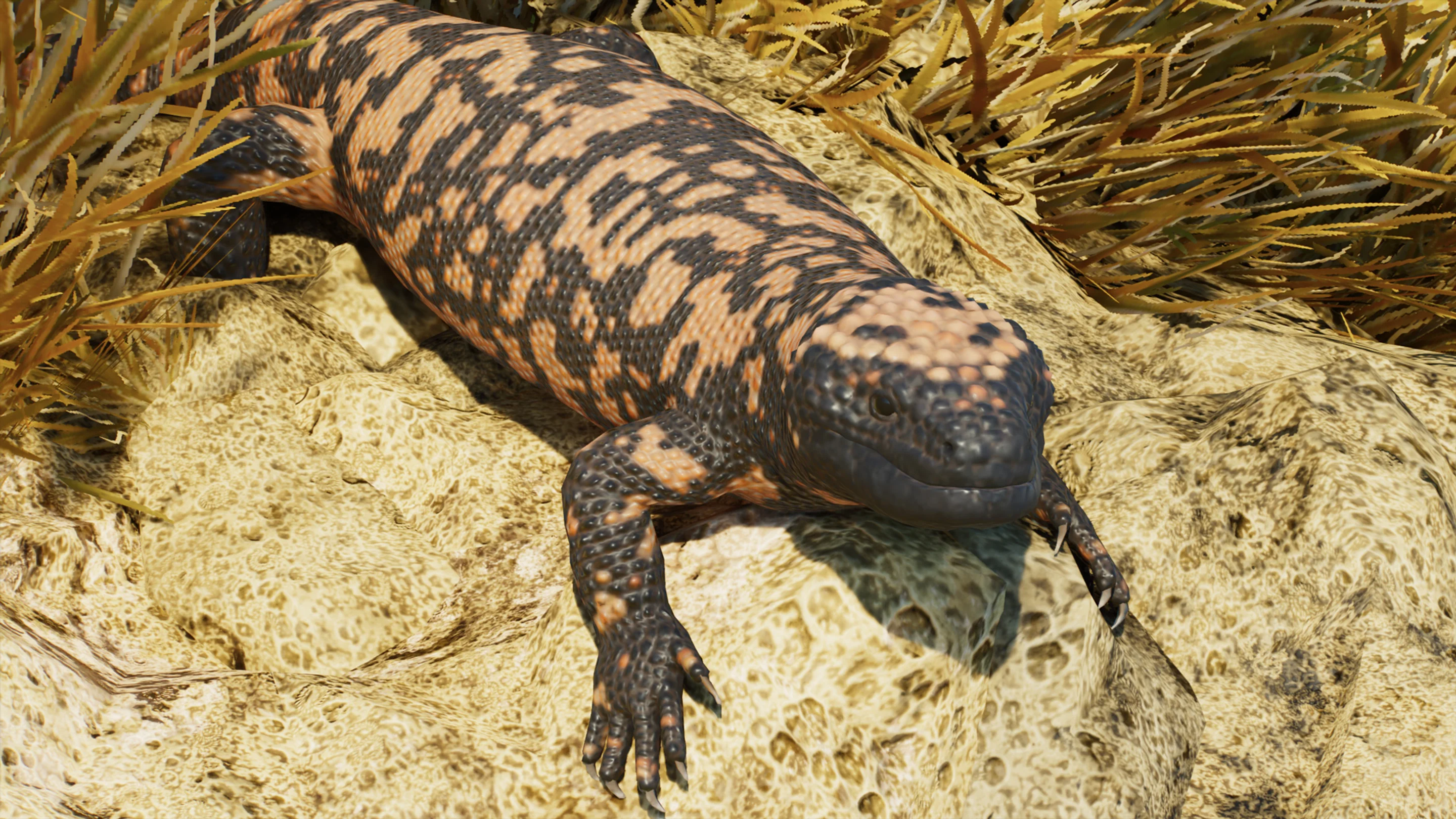
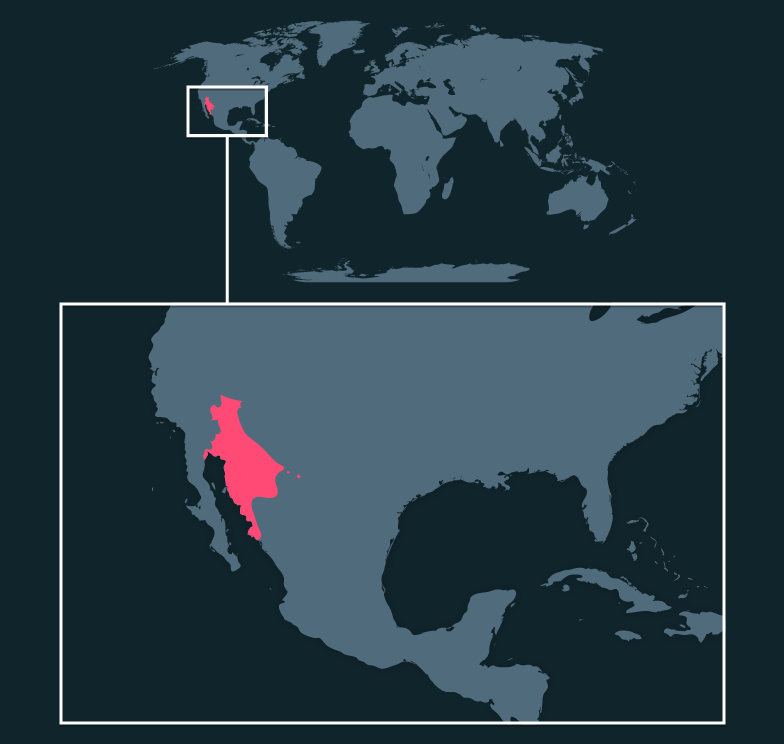
The Gila monster (or Heloderma suspectum) is a large species of venomous lizard native to the arid regions of the Southern United States and Northern Mexico.
It has orange and black scales arranged in a banded and reticulated pattern. The Gila monster has a very keen sense of smell that it uses for hunting, and can often be seen scenting the air by flicking its tongue in and out of its mouth.
The Gila monster measures 51cm to 60cm long, and weighs between 0.35kg and 0.7kg, making it the largest lizard native to the United States.
Gila monsters are solitary animals and only interact to mate and compete over mates.
Enrichments
Conservation Topics
Desert Ecosystem Ambience
Diurnal Behavior
Carnivore Diet
Reptile Evolution
Gila Monster Fact Sheet
Herpetology Talk
Habitat Loss
Poaching and the Exotic Pet Trade
Gila Monster Name Plate
Lifecycle
Gila monsters are solitary animals and only interact to mate and compete over mates.
During the mating season from May to June, male Gila monsters will track down females by scent. If he encounters one, he will attempt to climb on top of her. If she allows it, the two will mate, however she may reject this by biting him.
Approximately 2 months later, the female will dig a shallow nest in the sand and lay a clutch of 2 to 12 eggs, covering them over and leaving them to hatch 9 months later.
The young become fully grown and sexually mature Gila monsters after a period of between 3 and 5 years.
Statistics
Litter Size
1-2
Gestation / Incubation Period
9 months
Interbirth Period
3 months
Reproduction Difficulty
Easy
Age Of Sexual Sterility
Death
Age Of Sexual Maturity
4 years
Juvenile4 years
Adult26 years
Elderly0 years
Animal Facts
The Gila monster cannot inject venom like a snake. Instead, it administers venom by biting hard and chewing, aiming to put venom-laced saliva in the wound.
In the wild, the Gila monster only eats 5 to 10 times a year, and it spends the winter hibernating.
The Gila monster's venom is not deadly, but its bite is said to be one of the most painful.
A derivative of the Gila monster's venom is used in treating Type-2 diabetes.
Gila monster venom is being researched for potential uses in treating Alzheimer's disease.
Conservation
The Gila monster is Near Threatened, primarily affected by habitat loss due to urban and agricultural expansion. They are unable to cross fortified canals and highways, unable to reach more suitable habitat or dying to vehicle collisions while trying. In some areas, they are harvested for commercial or private collections. They are also often killed by humans out of fear, despite the fact that they are too slow moving to be a serious threat to people.
Gila monsters were the first venomous species to be legally protected in 1952. Today, they and their habitat are protected across all of their native range, and international trade is limited under CITES Appendix II. Translocations of Gila monsters from habitats at risk have proven unfruitful; these animals will attempt to return to their initial range at great risk. Public awareness campaigns improving the reputation and reducing fear in the population may instead help to promote a peaceful side-by-side where new settlements are built on Gila monster territory.
Native Range
North America
Statistics
Wild Population
Unknown
Conservation Status
Near Threatened
Are you ready to run a zoo?
Prove your knowledge and create a personalised certificate endorsed by the Fauna & Ecosystems Network for the Gila Monster.
Planet Zoo 2 is in active development and the Zoopedia reflects this work in progress. Text, images, stats etc. are not necessarily final and may change or be expanded upon.