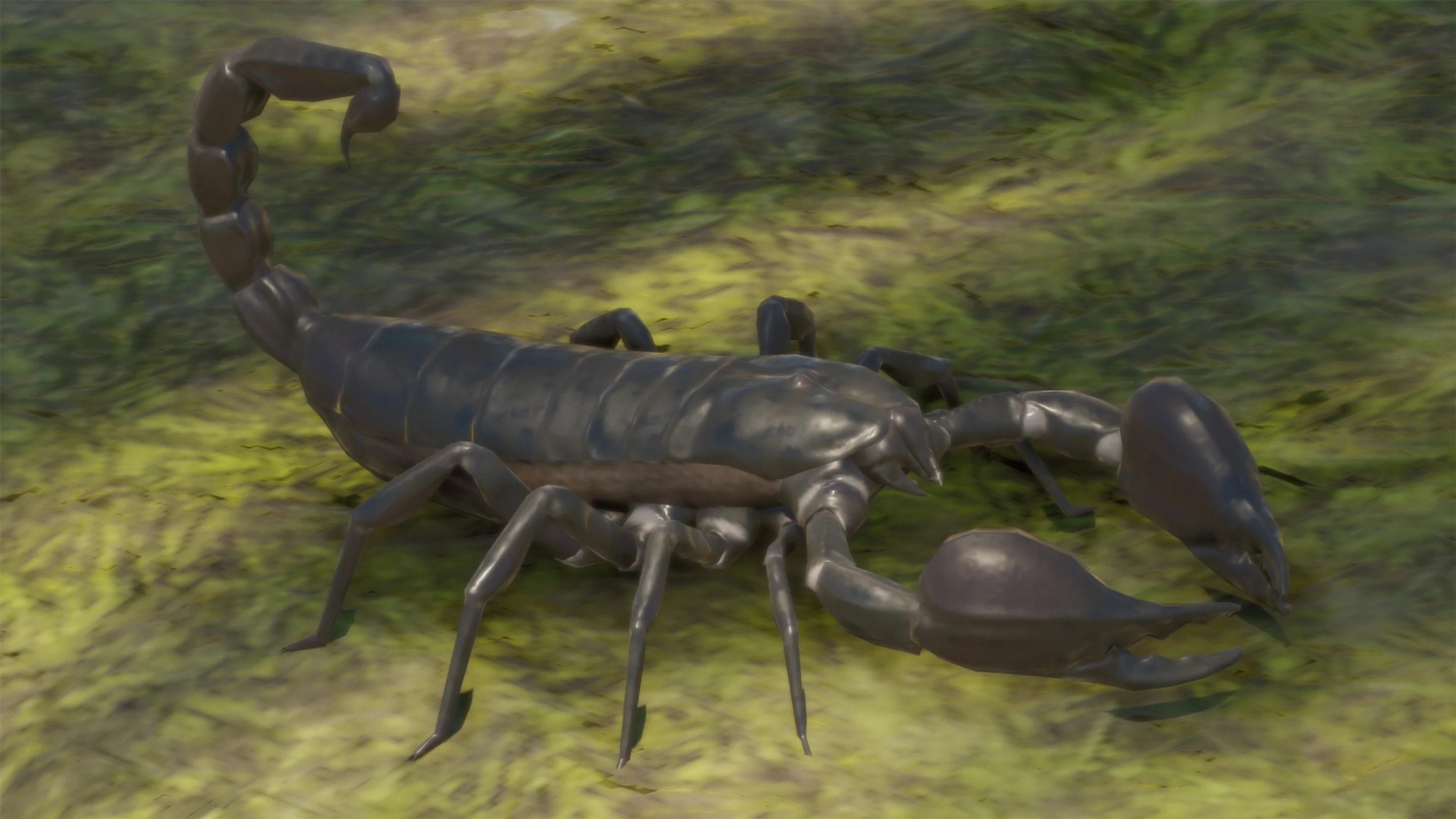
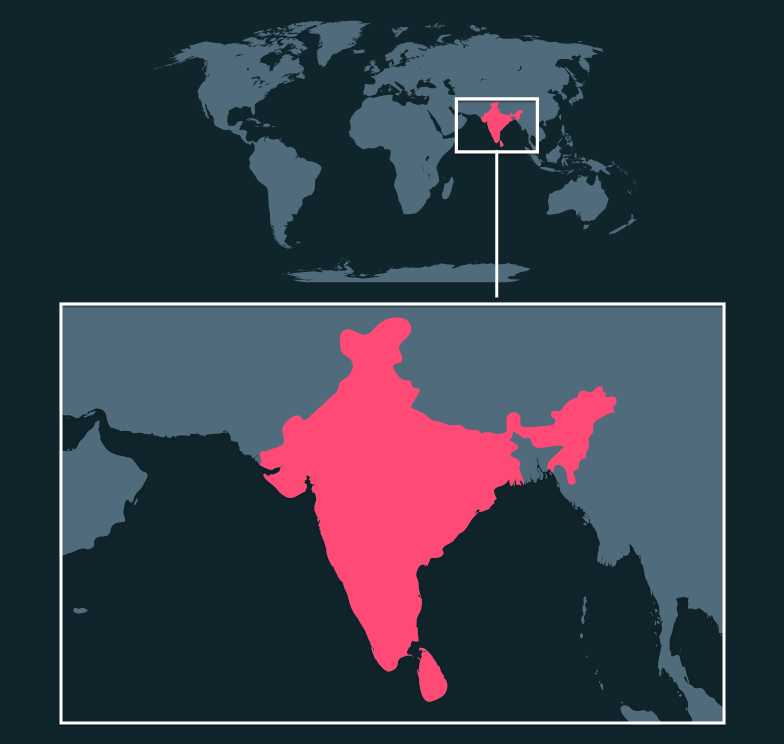
The giant forest scorpion (or Gigantometrus swammerdami) is a large species of arachnid that lives in the tropical rainforests of India and Sri Lanka.
It is a stout, black-colored animal with thick chitinous body plates and very large pincers. It may also have a blue or green sheen to its cuticle. The giant forest scorpion's pincers are strong and capable of catching and crushing prey, whereas its venom is relatively weak; most likely because it relies more on the strength of its pincers than the potency of its sting.
Giant forest scorpions are the largest species of scorpion in the world. On average, they can grow to 23cm long at a weight of 56g.
Giant forest scorpions are solitary animals, only interacting for mating purposes.
Enrichments
Conservation Topics
Rainforest Ecosystem Ambience
Nocturnal Behavior
Carnivore Diet
Arachnid Evolution
Giant Forest Scorpion Fact Sheet
The Arthropod World Talk
Giant Forest Scorpion Name Plate
Lifecycle
Giant forest scorpions are solitary animals, only interacting for mating purposes.
Giant forest scorpions mate year-round. When a receptive male and female come across each other, the male will grab her pedipalps (mouth parts) with his and pull her to an area of substrate that is suitable to complete the mating procedure. There he will deposit sperm on the ground from his abdomen and, if she acquiesces, he will move her onto the sperm so she can take it up via a pore on her abdomen.
The female will fertilize her eggs and incubate them for 5 to 8 months, after which she will give birth to live young that will climb onto her back. She carries them until they are 3 weeks old, have moulted, and are tough enough to be independent.
These young scorpions will reach sexual maturity between the ages of 1 and 3 years old.
Statistics
Litter Size
1-4
Gestation / Incubation Period
6 months
Interbirth Period
5 months
Reproduction Difficulty
Easy
Age Of Sexual Sterility
death
Age Of Sexual Maturity
2 years
Juvenile2 years
Adult6 years
Elderly0 years
Animal Facts
The giant forest scorpion is the largest species of scorpion in the world, reaching up to 23cm in length.
The giant forest scorpion, like all scorpions, glows under ultraviolet light.
The giant forest scorpion is more likely to use its pincers to attack than to use its sting.
Giant forest scorpions can survive a whole year without eating.
Giant forest scorpions can remain underwater for 48 hours and survive.
Conservation
The giant forest scorpion’s conservation status has not been formally assessed, and there is little targeted research into the conservation and threats of this species.
It may be under pressure from general habitat loss and degradation through logging and land conversion for agricultural use, and as the largest scorpion in the world, collection for the pet trade may also put some pressure on wild populations.
Currently, there is no protective legislation that directly targets the giant forest scorpion, although parts of its range are covered by protective areas where the habitat and population remain undisturbed. Further research into the giant scorpion to assess its wild population trend would be required as a basis for more specific conservation actions.
Native Range
Asia
Statistics
Wild Population
Unknown
Conservation Status
Not Evaluated
Are you ready to run a zoo?
Prove your knowledge and create a personalised certificate endorsed by the Fauna & Ecosystems Network for the Giant Forest Scorpion.
Planet Zoo 2 is in active development and the Zoopedia reflects this work in progress. Text, images, stats etc. are not necessarily final and may change or be expanded upon.