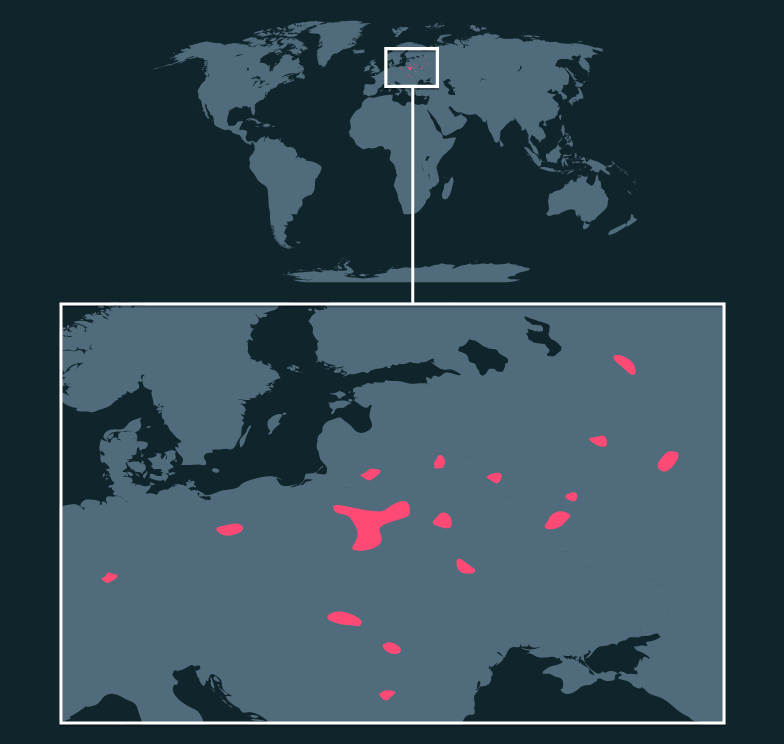
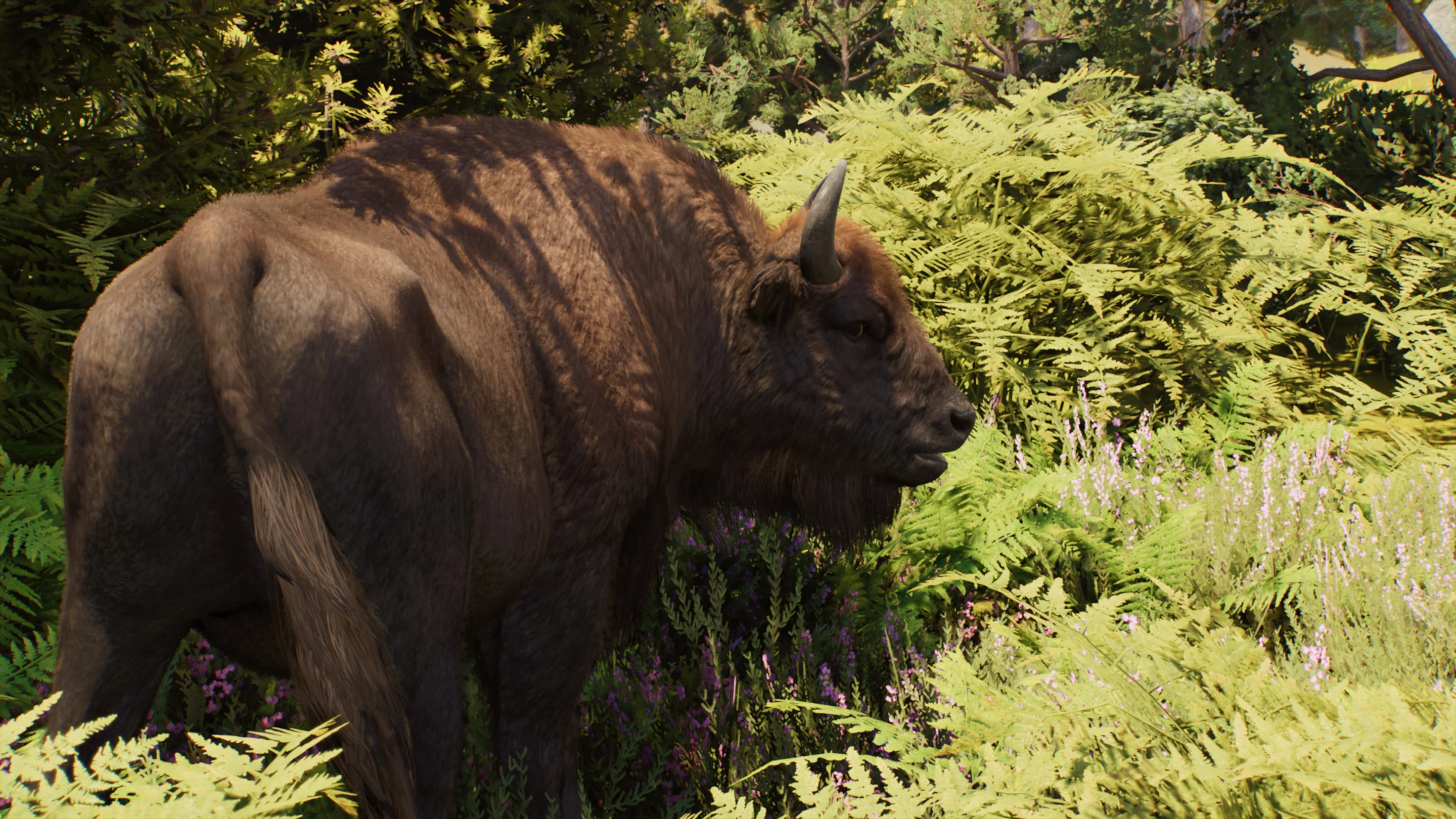
The European bison (or Bison bonasus), also commonly referred to as the wisent, is a large ungulate living in the forests and meadows of Poland, Russia, Belarus, Lithuania, Ukraine, and Slovakia, in Eastern Europe.
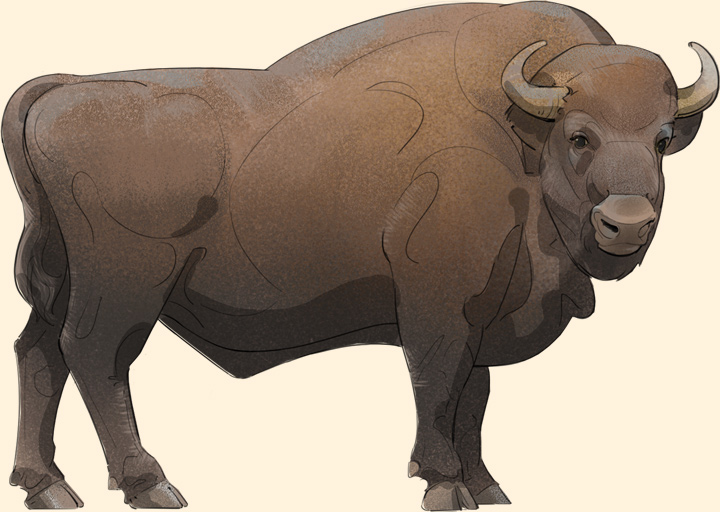
European bison are characterised by their large head, shoulder hump and well-muscled forequarters, all of which are covered in a brown, shaggy coat. The hindquarters are less bulky and are covered in a thinner coat. Both males and females have curled horns that point inwards towards the head and look otherwise alike, though males are larger by about 5%.
Bulls grow 1.8m to 2.1m tall at the shoulder, 2.8m to 3.3m long, and weigh 615kg to 920kg. Cows are 1.7m to 2m tall at the shoulder, reach a length between 2.4m to 2.9m and a weight of 425kg to 635kg.
European bison live in mixed herds of females and their offspring, including sub adult males. Mature males live together in pairs or trios, except for breeding periods, where they fight each other for access to a group of females. Mixed herds often come together to exchange individuals, so they do not live in exclusive familial units.
Enrichments
Food-Based Enrichments
Grazing Ball Feeder
Barrel Feeder - Hanging
Hanging Grazer Feeder
Barrel Feeder - Large
Melon Feeder
Scarecrow Feeder
Habitat Enrichments
Grab Ball
Large Ball
Rubbing Pillar
Skittle
Plant Screen
Mud Bath
Conservation Topics
Forest Ecosystem Ambience
Diurnal Behavior
Genetic Bottlenecks
Poaching and the Exotic Pet Trade
Species Reintroduction
Herbivore Diet
Mammal Evolution
European Bison Fact Sheet
Walking Animals
The Animal Kingdom Talk
European Bison Name Plate
Lifecycle
European bison live in mixed herds of females and their offspring, including sub adult males. Mature males live together in pairs or trios, except for breeding periods, where they fight each other for access to a group of females. Mixed herds often come together to exchange individuals, so they do not live in exclusive familial units.
In the mating season, taking place from August to October, dominant bulls, usually 6 years or older, attempt to join a group of females and defend them from rival males. Younger bulls will also join female groups, but are usually prevented from mating by the older male. If another mature bull approaches the herd, the two engage in a fight for their position. The bull assesses his female’s receptiveness to mating by sampling their urine. He will separate a female approaching oestrus from the group and guard her closely. When she is fertile, he will mount her to mate.
European bison cows are pregnant for 254 to 277 days, and give birth to a single calf. To deliver the calf, she leaves the herd for a few days, then returns with the infant. Weaning is complete when the calf is 14 months old.
Female European bisons reach sexual maturity at 3 years old, and remain with their mother’s herd. However, herds may exchange members when they meet, so herds aren’t exclusively family groups. Males become sexually mature at 2 years old and leave their natal group to join a bachelor herd, though they are unlikely to successfully mate until they are around 6 years old. At this point, they separate from their bachelor group and become solitary satellites hanging around the fringes of mixed groups until the next breeding season.
Colourmorphs
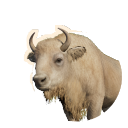
Leucistic
Statistics
Litter Size
1-1
Gestation / Incubation Period
8 months
Interbirth Period
15 months
Reproduction Difficulty
Easy
Age Of Sexual Sterility
20 years
Age Of Sexual Maturity
3 years
Juvenile3 years
Adult17 years
Elderly8 years
Animal Facts
In Poland, the European bison is known as the zubr and is the national animal of the county.
During summer, an adult male European bison may eat up to 32kg of food in a day.
The European bison used to be heavily hunted for its hide, meat, and horns which were used to make drinking horns.
There used to be 3 subspecies of the European bison, two of which are fully extinct now: the Carpathian European bison (B. b. hungarorum), native to Moldova, Romania, Hungary, and Ukraine, and the Caucasian European bison (B. b. caucasicus), native to the Caucasus Mountains in Georgia, Russia, Azerbaijan, and Armenia. The type species (B. b. bonasus) is the European bison we know today and the only subspecies to recover from extinction.
The European bison is the heaviest terrestrial mammal in Europe, with bulls occasionally weighing over 1,000kg. The record weight attained by a European bison is 1,900kg, though generally this species is lighter than their American relatives.
Conservation
Today, the European bison is considered a Near Threatened species. By the early 20th century, European bisons were driven to extinction in the wild due to overhunting and habitat loss. Only 60 individuals remained in captive or managed groups. Consequently, the species was offered widespread protection, and, through captive breeding and reintroduction programmes, the European bison was saved from disappearing completely.
Deforestation and habitat loss through agricultural development, as well as inbreeding depression and hybridisation with domestic cattle, still threaten the species today. Bovine tuberculosis transmitted by livestock also poses a risk. Carefully managed populations of European bisons have been successfully reintroduced in many areas of Europe, with further reintroductions planned. Reintroduction efforts have seen significant success, especially in Poland’s Białowieża Forest and Romania’s Southern Carpathians multiple free-ranging populations have been established.
Native Range
Europe
Statistics
Wild Population
2,518
Conservation Status
Near Threatened
Valid Reserves
Poland Reserve
Valid Release Group Types
Mixed Group
Male Bachelor Herd
Are you ready to run a zoo?
Prove your knowledge and create a personalised certificate endorsed by the Fauna & Ecosystems Network for the European Bison.
Planet Zoo 2 is in active development and the Zoopedia reflects this work in progress. Text, images, stats etc. are not necessarily final and may change or be expanded upon.



 Grazing Ball Feeder
 Barrel Feeder - Hanging
 Hanging Grazer Feeder
 Barrel Feeder - Large
 Melon Feeder
 Scarecrow Feeder
 Grab Ball
 Large Ball
 Rubbing Pillar
 Skittle
 Plant Screen
 Mud Bath