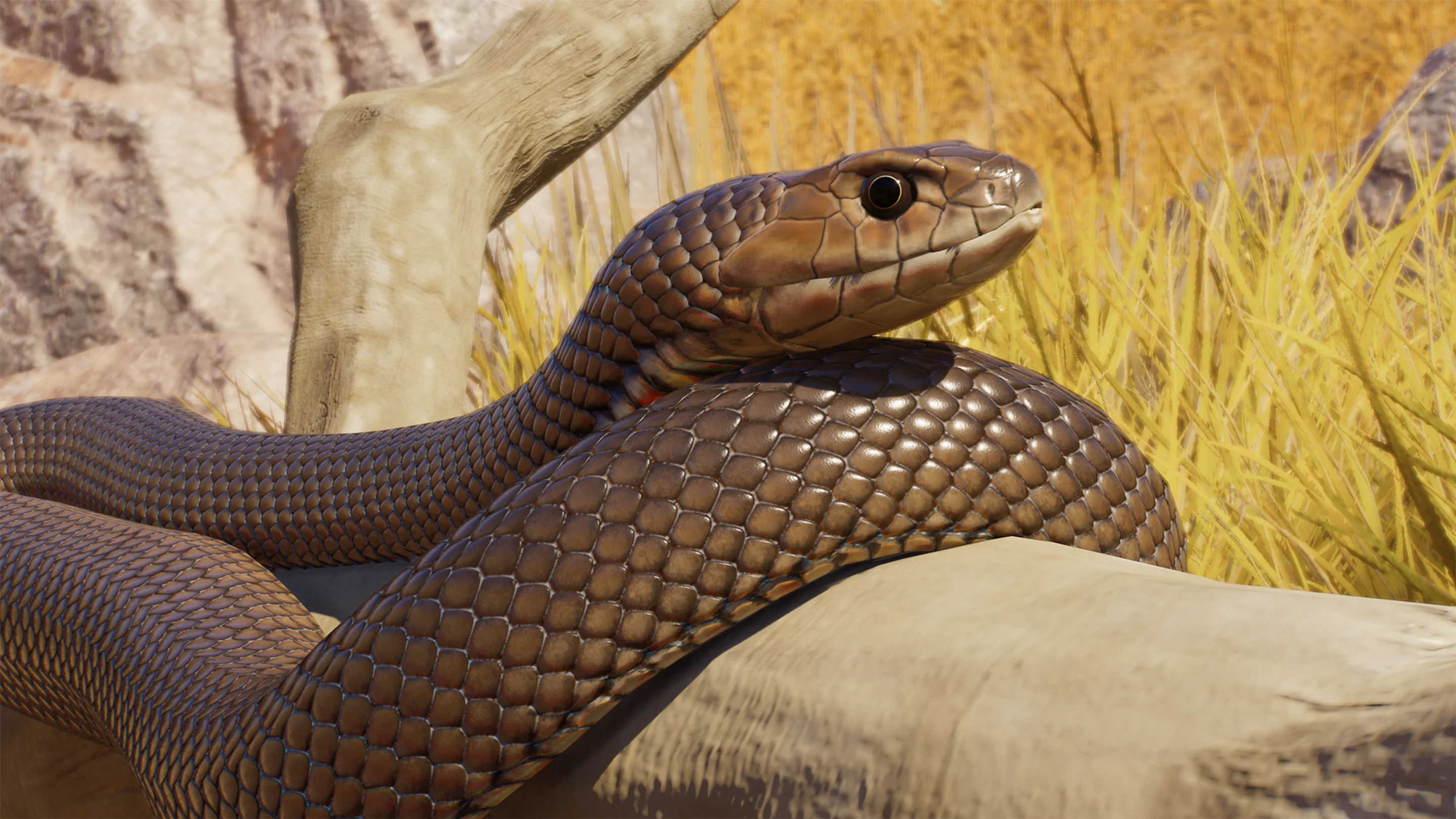
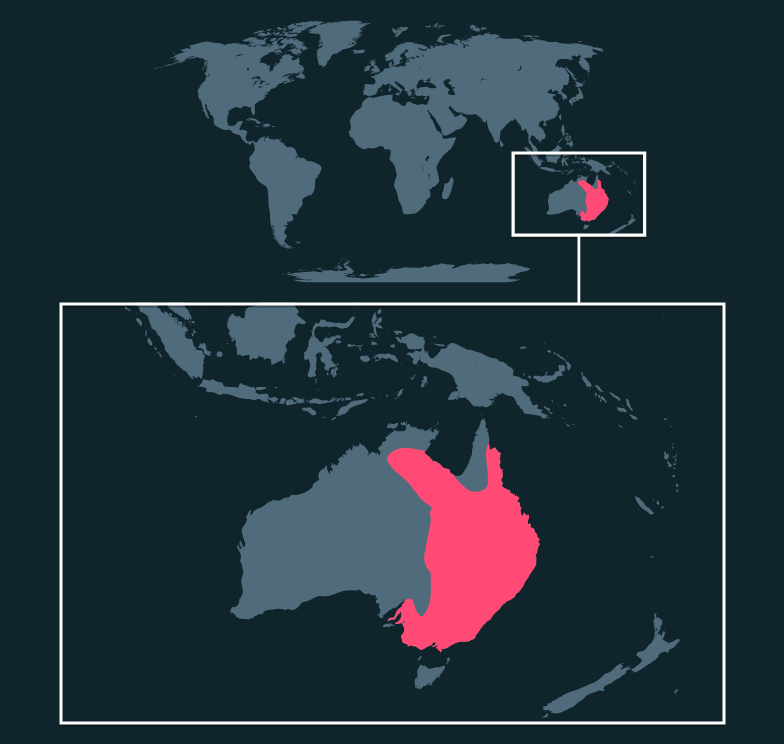
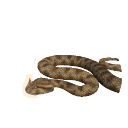
The Eastern brown snake (or Pseudonaja textilis) is a venomous species of reptile that lives in Australia and New Guinea. It prefers to live in dry areas so can be found in the grassland, scrubland and sparse forests.
The snakes are pale to dark brown in color, often with a paler underside, and they may have slightly darker brown mottling on their scales as camouflage. The species is known for its defensive displays, whereby it will lift much of its head and body off the ground and coil it into an S-shape with its mouth open. These displays are often mistaken for aggression.
Eastern brown snakes usually measure between 1.5m and 2m in length.
Adult male Eastern brown snakes are solitary, whereas females may interact with each other after laying their eggs; they will often do this in the same burrow as one another, guarding them together.
Enrichments
Conservation Topics
Savannah Ecosystem Ambience
Diurnal Behavior
Carnivore Diet
Reptile Evolution
Eastern Brown Snake Fact Sheet
Herpetology Talk
Eastern Brown Snake Name Plate
Lifecycle
Adult male Eastern brown snakes are solitary, whereas females may interact with each other after laying their eggs; they will often do this in the same burrow as one another, guarding them together.
Mating season is generally between September and November during spring, after emerging from winter hibernation in their underground burrows. Males then search for females by tracking chemical signals. If the female is receptive, the male rubs his head up and down her body, and then twists his lower body around hers. Mating can take several hours. Both males and females may mate with multiple partners during the breeding season.
The female lays between 10 and 35 eggs in an underground burrow – often the abandoned burrow of a small mammal – and will guard them for about 5 weeks before leaving them for good.
The eggs will hatch after 11 weeks and the hatchlings are completely independent from when they emerge. They will be fully grown at approximately 31 months old.
Colourmorphs
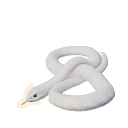
Albino
Statistics
Litter Size
2-3
Gestation / Incubation Period
2 months
Interbirth Period
9 months
Reproduction Difficulty
Easy
Age Of Sexual Sterility
Death
Age Of Sexual Maturity
2 years
Juvenile2.5 years
Adult12.5 years
Elderly0 years
Animal Facts
Eastern brown snakes are the second-most venomous snake in the world.
The genus of brown snakes are the most common cause of snake bite deaths in Australia.
Eastern brown snakes hibernate in underground burrows during the winter.
Male brown snakes will fight over females, twisting themselves together tightly and attempting to force the other's head to the ground.
The Latin name for the Eastern brown snake is 'Pseudonaja' which translates to 'false cobra'.
Conservation
The eastern brown snake is considered a species of Least Concern. It is unlikely that any major threats affect this species. It thrives in agricultural regions and city peripheries due to abundant prey like rats, as well as in its native habitats. It is sometimes kept as a pet.
The eastern brown snake is found in protected areas of Australia, but otherwise has no ongoing conservation actions.
The long-term outlook for this species appears to be a stable population in its native range, though additional surveys may be useful to better understand its distribution.
Native Range
Oceania
Statistics
Wild Population
Unknown
Conservation Status
Least Concern
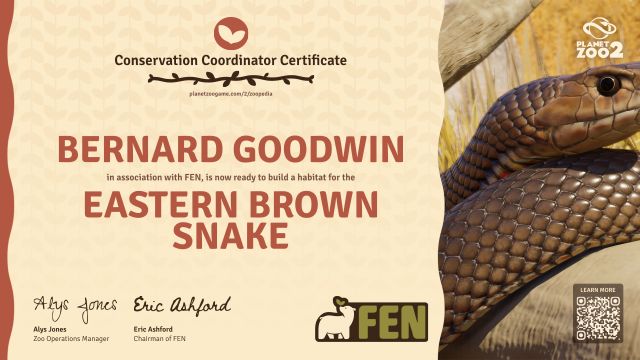
Are you ready to run a zoo?
Prove your knowledge and create a personalised certificate endorsed by the Fauna & Ecosystems Network for the Eastern Brown Snake.
Planet Zoo 2 is in active development and the Zoopedia reflects this work in progress. Text, images, stats etc. are not necessarily final and may change or be expanded upon.