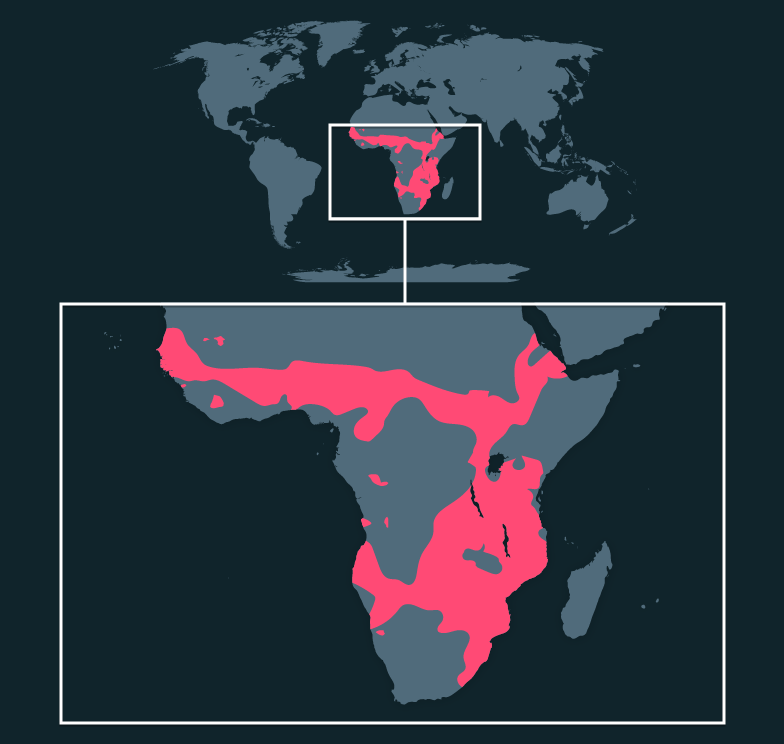
The common warthog (or Phacochoerus africanus) lives throughout Sub-Saharan Africa in a wide variety of environments.
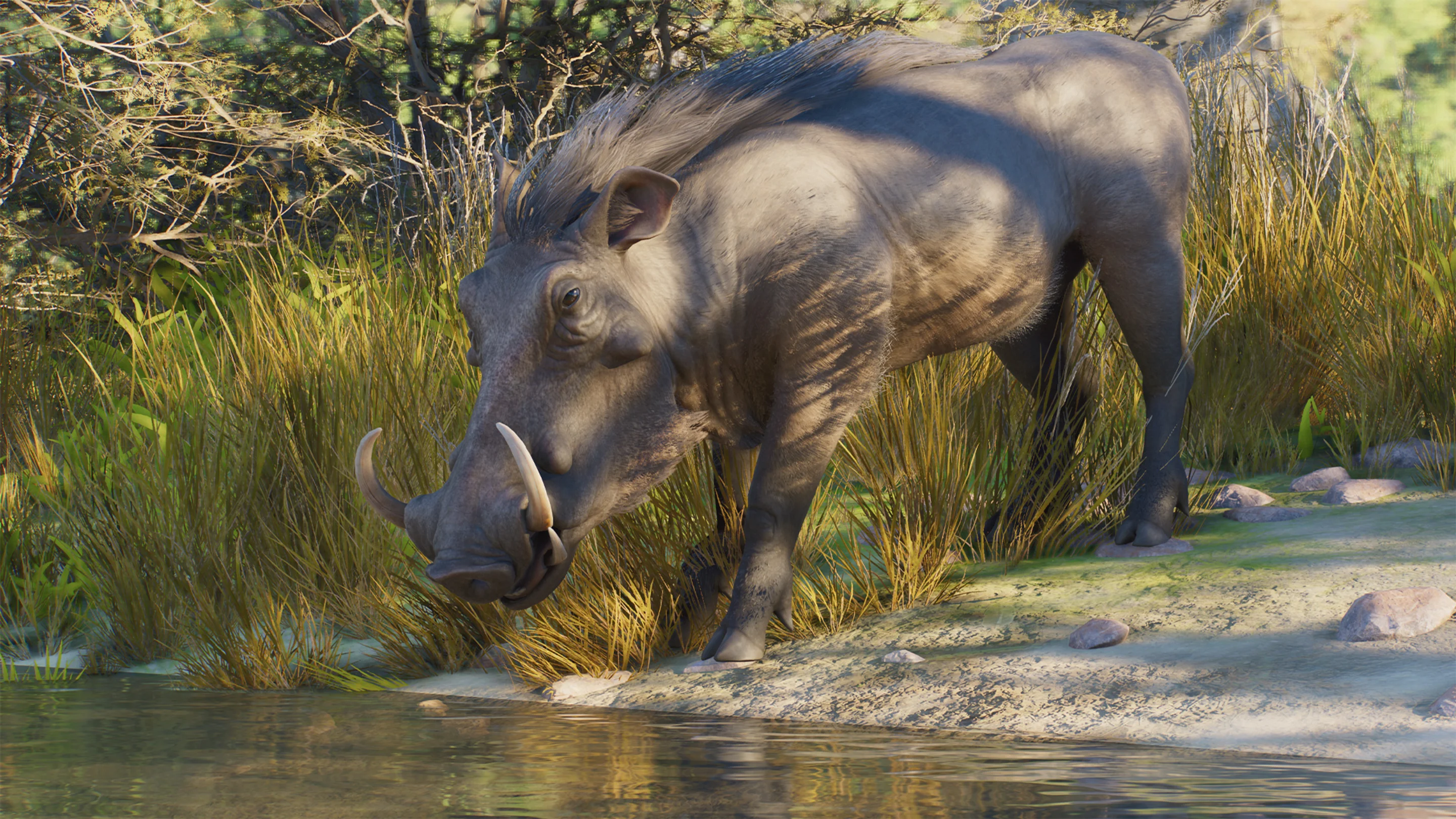
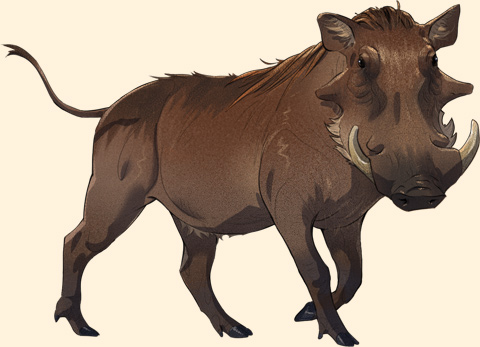
The common warthog has a large head with a coarse mane of hair and distinctive tusks. The upper tusks are large, thick and blunt, while the lower tusks are short and sharp. Warthogs also have large cartilaginous protrusions on their cheeks.
The males average between 1.3 and 1.5m in length and between 60 and 150kg in weight, whereas females are shorter and lighter, averaging between 0.9 to 1.3m long and 45 to 75kg in weight.
Males fight for right to mate. Females have rank in groups based on age.
Guests Can Walk Through
false
Warthogs have a complex social structure. Mature females tend to live in interrelated groups with their offspring. However, year-old piglets may leave their mother's group and live in sibling groups, before splitting up as they get older. The young females usually return to their mother's group, whereas young males will form bachelor herds until they are old and strong enough to become solitary.
Enrichments
Food-Based Enrichments
Dog Ball
Suspended Veggie Feeder
Melon Feeder
Habitat Enrichments
Cardboard Box
Herb Scent Marker
Sprinkler
Rubbing Pad
Rubbing Pad Bark
Small Ball
Small Ice Ball
Mud Bath
Conservation Topics
Savannah Ecosystem Ambience
Diurnal Behavior
Human-Wildlife Conflict
Infectious Disease
Poaching and the Exotic Pet Trade
Omnivore Diet
Mammal Evolution
Common Warthog Fact Sheet
Walking Animals
The Animal Kingdom Talk
Common Warthog Name Plate
Lifecycle
Warthogs have a complex social structure. Mature females tend to live in interrelated groups with their offspring. However, year-old piglets may leave their mother's group and live in sibling groups, before splitting up as they get older. The young females usually return to their mother's group, whereas young males will form bachelor herds until they are old and strong enough to become solitary.
Common warthogs mate from January to June. Male warthogs have two strategies for mating. These are called 'tending' and 'roaming'. A tending male will join a sounder of females during the mating season and block other males from coming close; as well as try to stop females going to other males. Roaming males search for multiple sounders and attempt to mate with females from these groups, often competing with the tending male.
Female common warthogs are pregnant for 5-6 months before giving birth to 1 to 5 piglets in their burrow, away from their sounder. They nurse their piglets there for several weeks, before returning to the sounder. The young piglets begin eating solid food at 3 weeks old and are fully weaned by 6 months old.
Piglets reach sexual maturity at 2 years old, although males are unlikely to mate for the first time until they are 4 to 5 years old. Females remain with their sounder, while males join bachelor groups, becoming fully solitary as they age.
Colourmorphs
Leucistic
Statistics
Litter Size
1-5
Gestation / Incubation Period
5 months
Interbirth Period
7 months
Reproduction Difficulty
Easy
Age Of Sexual Sterility
death
Age Of Sexual Maturity
2 years
Juvenile2 years
Adult8 years
Elderly11 years
Animal Facts
The warthog's genus name, Phacochoerus, derives from the Ancient Greek words 'phakós' - wart and 'khoîros' - pig.
The upper tusks of the common warthog can grow up to 25cm long.
Common warthogs sleep in the abandoned burrows of other animals, usually aardvarks.
The tusks of the warthog shear against each other, making the bottom tusks razor sharp. Warthogs use these for attacking predators.
Common warthogs back into their burrows so that they are facing outwards and can charge at predators if they are at risk.
Conservation
Although populous, adaptable, and of Least Concern, the common warthog does experience some pressure from habitat loss and human-wildlife conflict. Human expansion results in loss of access to savannah and grassland habitats, reducing availability of food and burrow sites. Additionally, they are sometimes killed by farmers trying to protect crops or livestock, as their foraging destroys harvest and they may spread diseases to other animals. Poaching and trophy hunting also contributes to localized population declines.
Common warthogs benefit from general conservation efforts across their range, such as habitat protection, campaigns for sustainable land-use practices, and community-based wildlife management, such as ecotourism initiatives or crop-protection strategies. Specific monitoring efforts and enforcement of anti-poaching laws further support their long-term survival, aiming to ensure that common warthogs remain a resilient and integral part of Africa’s savannah ecosystems.
Native Range
Africa
Statistics
Wild Population
250,000
Conservation Status
Least Concern
Valid Reserves
Great Rift Valley Reserve
Tanzania Reserve
Valid Release Group Types
Male Bachelor Herd
Female Bachelor Herd
Solitary Male
Are you ready to run a zoo?
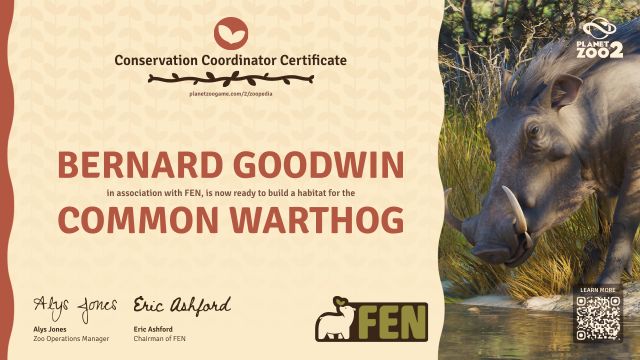
Prove your knowledge and create a personalised certificate endorsed by the Fauna & Ecosystems Network for the Common Warthog.
Planet Zoo 2 is in active development and the Zoopedia reflects this work in progress. Text, images, stats etc. are not necessarily final and may change or be expanded upon.

















 Dog Ball
 Suspended Veggie Feeder
 Melon Feeder
 Cardboard Box
 Herb Scent Marker
 Sprinkler
 Rubbing Pad
 Rubbing Pad Bark
 Small Ball
 Small Ice Ball
 Mud Bath