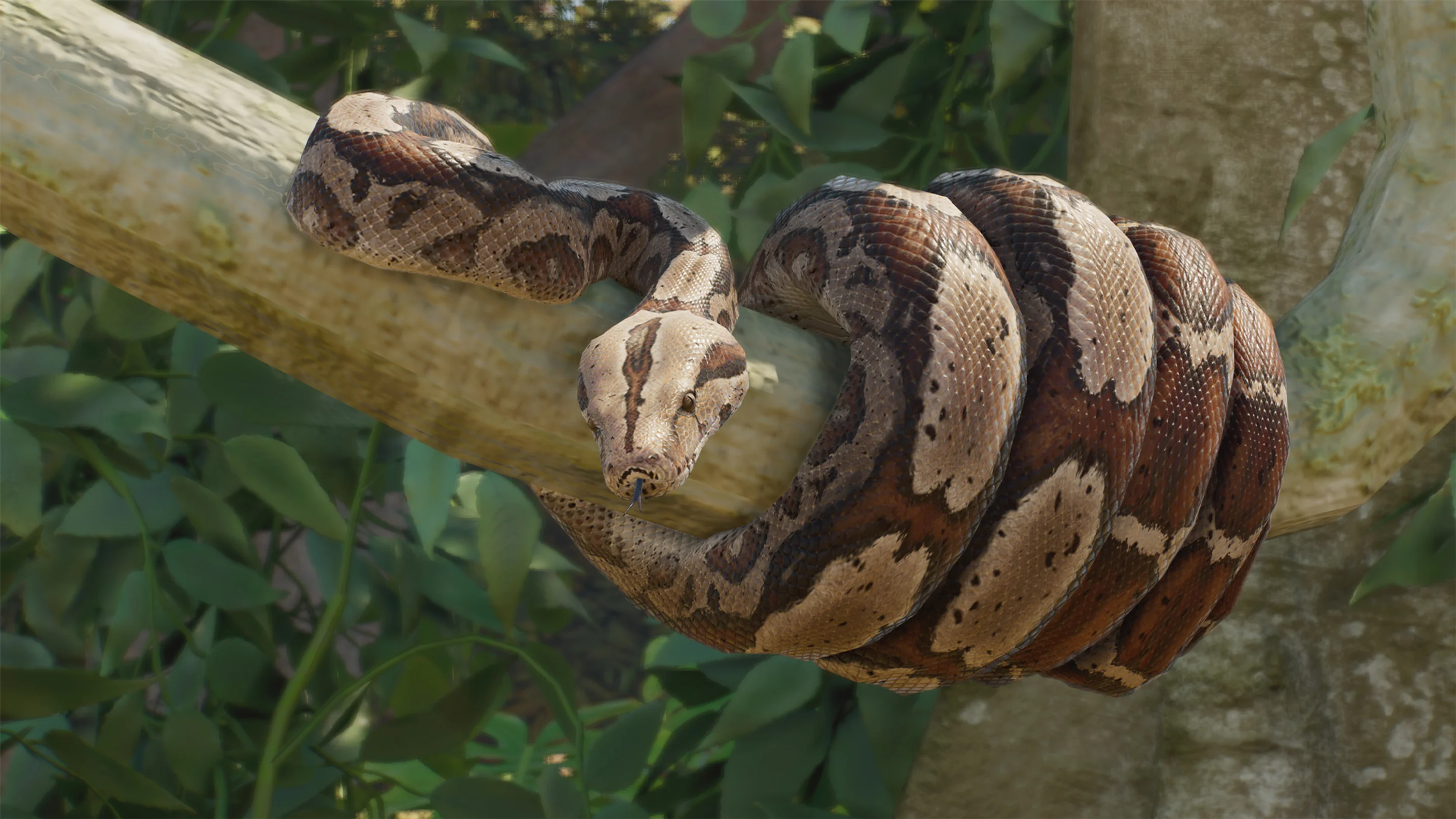
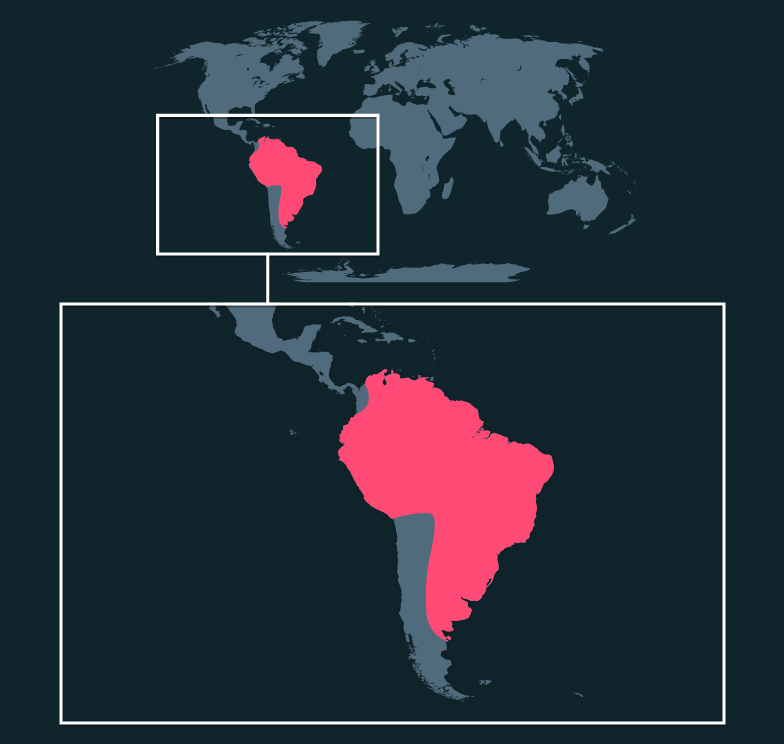
The boa constrictor is a large species of snake native to Central and South America. It is also known as the red-tailed boa but is most commonly referred to using its scientific binomial name. The boa constrictor is a ubiquitous species with multiple subspecies, all of which are mostly found in rainforests, coastal areas and semi-deserts.
Although there are many different colors and patterns among these snakes, the typical appearance is pale brown, dark brown and black scales in a rhomboid pattern down the length of the body.
Males are an average length of between 1.8m and 2.4m, with pelvic spurs around their cloaca that are used to facilitate mating. Females are larger, with an average length of between 2.1m and 3m, whilst they have pelvic spurs they are smaller than the male's.
Boa constrictors are solitary animals and do not interact in the wild, except when mating or fighting over mating rights.
Enrichments
Conservation Topics
Rainforest Ecosystem Ambience
Nocturnal Behavior
Carnivore Diet
Reptile Evolution
Boa Constrictor Fact Sheet
Herpetology Talk
Poaching and the Exotic Pet Trade
Habitat Loss
Boa Constrictor Name Plate
Lifecycle
Boa constrictors are solitary animals and do not interact in the wild, except when mating or fighting over mating rights.
Mating occurs in the dry season between April and August. Female boas will release pheromones that males will track. If more than one male encounters the same female, they will wrestle with each other, the victor then mating with the female. The female will store the male's sperm until she ovulates, using it to fertilize her eggs.
She gestates for between 100 and 120 days, giving birth to between 20 and 65 live young, which are independent from birth.
Boa constrictors reach sexual maturity between 3 and 4 years old.
Colourmorphs
Albino
Statistics
Litter Size
1-1
Gestation / Incubation Period
4 months
Interbirth Period
20 months
Reproduction Difficulty
Easy
Age Of Sexual Sterility
Death
Age Of Sexual Maturity
3 years
Juvenile3 years
Adult37 years
Elderly0 years
Animal Facts
Boas and pythons have a rudimentary pelvis and vestigial hind legs inside their body.
The scale color and pattern of boa constrictors depends on where they are from; there are a huge range of colors in the wild and even more in captivity due to selective breeding.
Boa constrictors give birth to live young.
Boa constrictors will shed their skin every 2 to 4 months as they continue to grow throughout their life.
Contrary to popular belief, boa constrictors do not kill their prey by suffocation, but by cutting off blood supply to vital organs.
Conservation
Boa constrictors are considered a species of Least Concern. The species is hunted for its skin and meat both legally and illegally, and is collected for the pet trade where it is one of the most common snakes kept in captivity. The species is in gradual decline across South America, where there is significant habitat degradation due to mining, oil and agriculture.
Protected areas across the habitat range for the broader ecosystem are beneficial for the conservation of the boa constrictor. Trade in the species is internationally regulated, and institutional research is ongoing. The long-term outlook for this species is reasonable, and broader protections and management are not currently being sought.
Native Range
South America, Central America
Statistics
Wild Population
Unknown
Conservation Status
Least Concern
Are you ready to run a zoo?
Prove your knowledge and create a personalised certificate endorsed by the Fauna & Ecosystems Network for the Boa Constrictor.
Planet Zoo 2 is in active development and the Zoopedia reflects this work in progress. Text, images, stats etc. are not necessarily final and may change or be expanded upon.