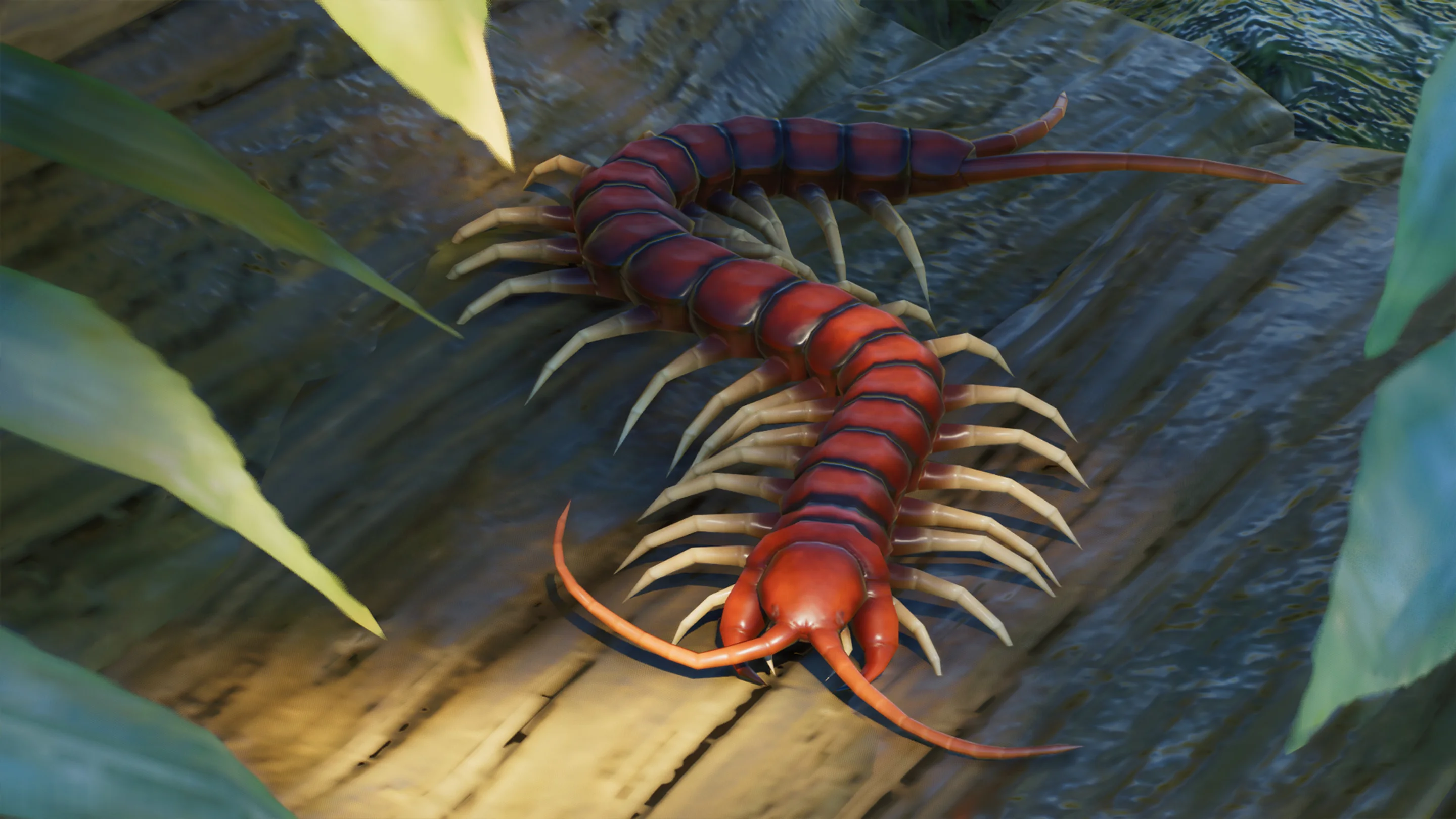
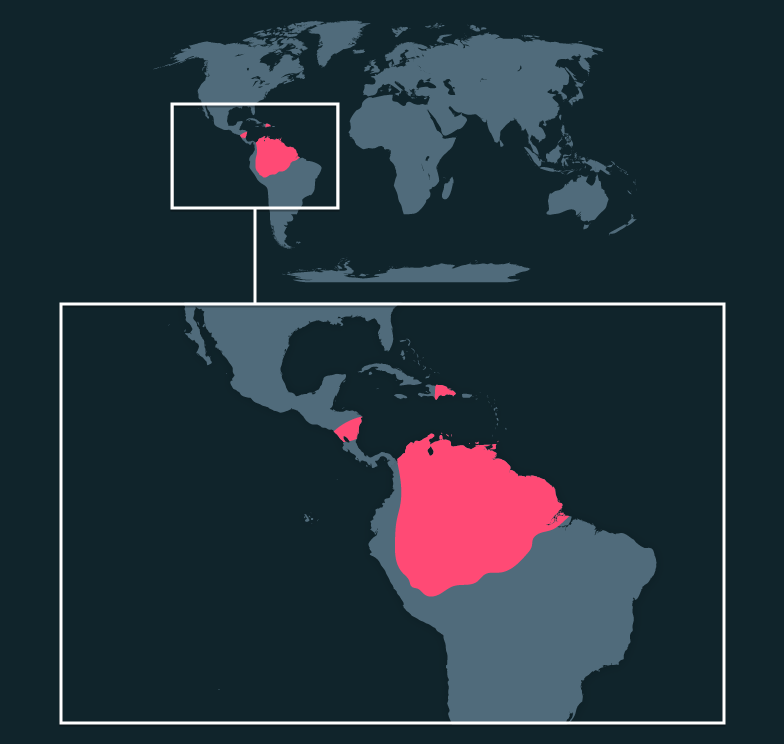
The Amazonian giant centipede (or Scolopendra gigantea) is a large, fearsome and predatory arthropod that is native to the forests of South America and the Caribbean.
It has a segmented long body of either 21 or 23 segments, with one pair of legs per segment. It injects venom though pincer-like front legs called forcipules and can catch a variety of small prey using specific techniques. It occurs in a variety of colors – typically red, yellow, brown or black – with yellow legs and dark stripes between body segments.
The centipede can reach 30cm in length, and females tend to bear more legs than males.
Amazonian Giant Centipedes are solitary in the wild and therefore should be kept alone in captivity.
Enrichments
Conservation Topics
Rainforest Ecosystem Ambience
Nocturnal Behavior
Carnivore Diet
Centipede Evolution
Amazonian Giant Centipede Fact Sheet
Amazonian Giant Centipede Name Plate
Lifecycle
Amazonian Giant Centipedes are solitary in the wild and therefore should be kept alone in captivity.
The Amazonian giant centipede can breed year-round but does not involve copulation. In order to reproduce, male centipedes deposit a protein parcel containing sperm called a 'spermatophore' on the ground for a female to find. When the female comes across this, she will absorb and use it to fertilize her eggs, laying between 15 and 60 in a burrow in the soil.
She guards the eggs until they hatch, regularly licking them to prevent fungus from growing on them.
Once hatched, the mother will continue to care for them for approximately 3 months, often carrying them on her underside and wrapping herself around them to guard them. The young centipedes will reach sexual maturity at approximately 2 years old.
Statistics
Litter Size
1-4
Gestation / Incubation Period
4 months
Interbirth Period
8 months
Reproduction Difficulty
Easy
Age Of Sexual Sterility
death
Age Of Sexual Maturity
2 years
Juvenile2 years
Adult8 years
Elderly0 years
Animal Facts
Although 'centipede' means '100 legs', they only have a pair of legs per body segment (usually 21 or 23 segments).
The Amazonian giant centipede, and all centipedes, breathe through holes on the sides of their body segments.
The bite and venom of the Amazonian giant centipede has been confirmed to be responsible for one human death.
The Amazonian giant centipede will eat any animal it can catch and kill, including tarantulas and small snakes.
Amazonian giant centipedes have been known to climb onto the top of caves and hang downwards in order to prey upon bats.
Conservation
The status of the Amazonian giant centipede has not been officially evaluated. It is an important generalist predator in tropical ecosystems that helps control insect and small animal populations. It needs the warm and high humidity of its native environment and hides during the day to avoid dehydration. It may be targeted for pest control, as its bite and venom are painful to humans, but serious reactions and fatalities are rare. True infestations are rare due to its solitary nature.
The species is not considered invasive even though it is sometimes accidentally transported in goods and plant materials from tropical regions.
The outlook for the Amazonian giant centipede is stable considering its widespread population, large native range and overall lack of threats.
Native Range
South America
Statistics
Wild Population
Unknown
Conservation Status
Not Evaluated
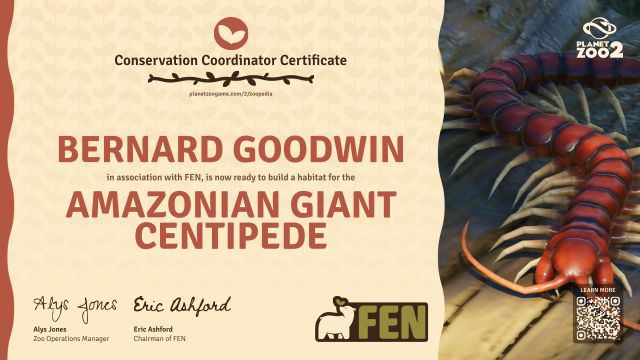
Are you ready to run a zoo?
Prove your knowledge and create a personalised certificate endorsed by the Fauna & Ecosystems Network for the Amazonian Giant Centipede.
Planet Zoo 2 is in active development and the Zoopedia reflects this work in progress. Text, images, stats etc. are not necessarily final and may change or be expanded upon.