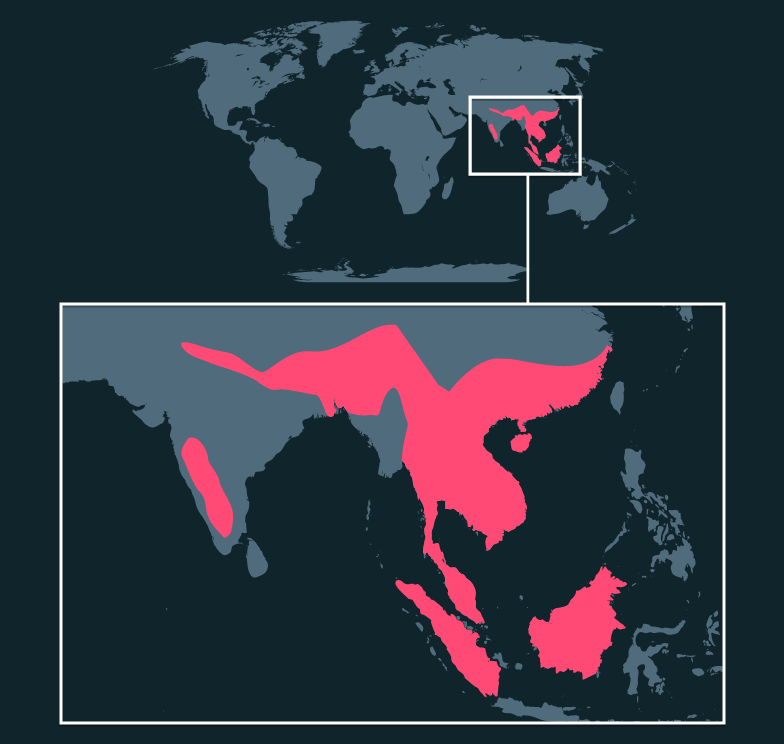
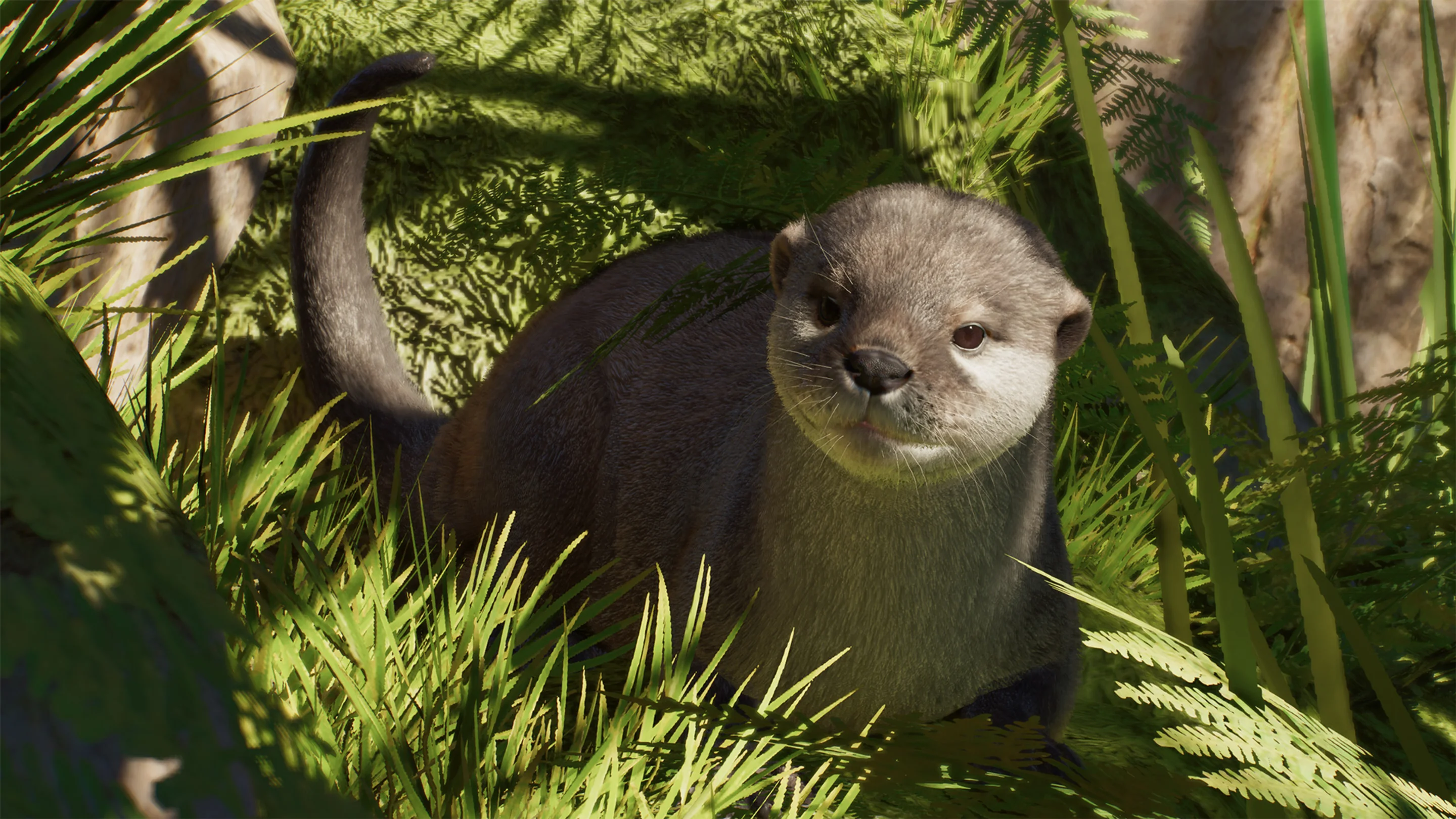
Native to the rivers and streams of Central and Southeast Asia, the Asian small-clawed otter (or Aonyx cinereus) is the smallest otter species in the world.
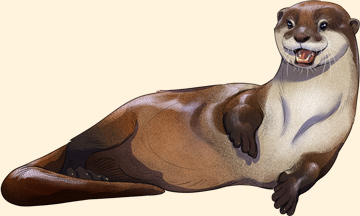
Its sleek body is covered in brown fur, with a white belly and throat.
Asian small-clawed otters grow between 72cm and 96cm in total body length and weigh 2.7kg to 5.4kg. There are no notable physical differences between females and males of this species.
Asian small-clawed otters are very social and intelligent animals, living in family groups of around 15 members. These groups are led by a dominant mated pair and their offspring across various litters. Family groups break apart if they become too large or one of the leaders dies – in this case, family members will leave and attempt to form new breeding groups with other unrelated individuals.
Enrichments
Food-Based Enrichments
Bamboo Feeder
Block of Frozen Fish
Dog Ball
Habitat Enrichments
Tennis Ball
Cardboard Box
Submarine Buoy
Platform Floats
Sprinkler
Water Hoop
Conservation Topics
Wetland Ecosystem Ambience
Diurnal Behaviour
Habitat Loss
Poaching and the Exotic Pet Trade
Piscivore Diet
Mammal Evolution
Asian Small-Clawed Otter Fact Sheet
Swimming Animals
The Animal Kingdom Talk
Pollution
Asian Small-Clawed Otter Name Plate
Lifecycle
Asian small-clawed otters are very social and intelligent animals, living in family groups of around 15 members. These groups are led by a dominant mated pair and their offspring across various litters. Family groups break apart if they become too large or one of the leaders dies – in this case, family members will leave and attempt to form new breeding groups with other unrelated individuals.
When the dominant female of a group is in oestrus, she and the dominant male spend bonding time playing and nuzzling. The pair mates several times over the female’s fertile period, where copulation can be initiated by either the male or female, and lasts between 5 to 25 minutes.
Pregnancies in Asian small-clawed otters last for a period of 68 to 74 days, after which the female gives birth to a litter of between 1 and 6 pups, with an average litter size of 2. The pups are born blind and open their eyes after 1 to 1.5 months after birth, which is also when they will begin moving around independently. They will usually leave the den and have their first swim at around 2 months old. Weaning begins at 4 months old, though pups may already begin consuming solid food 1 to 2 months prior, and is usually complete by 8 months old.
Asian small-clawed otters reach sexual maturity at 1.5 to 2 years old but remain with the family group without breeding. Instead, older pups help raising their siblings. New families are formed with unrelated individuals when existing family groups split up due to size or death of one of the leaders.
Colourmorphs
Albino
Statistics
Litter Size
1-3
Gestation / Incubation Period
2 months
Interbirth Period
9 months
Reproduction Difficulty
Easy
Age Of Sexual Sterility
death
Age Of Sexual Maturity
2 years
Juvenile2 years
Adult8 years
Elderly6 years
Animal Facts
Asian small-clawed otters are monogamous and mate for life.
The Asian small-clawed otter can close its ears and nostrils when swimming.
Despite living in groups, Asian small-clawed otters generally hunt for themselves.
The Asian small-clawed otter is extremely dexterous in comparison to other otter species due to short claws and incomplete webbing between its toes.
Grooming is extremely important for Asian small-clawed otters as it traps air between the hair follicles, keeping otters insulated and dry while swimming.
Conservation
As a Vulnerable species, Asian small-clawed otters face threats from habitat loss, pollution, and wildlife trade. Rapid urbanisation and the conversion of wetlands and mangroves into aquaculture farms have severely fragmented their natural habitats. Additionally, water pollution from pesticides, heavy metals, and industrial runoff degrades freshwater ecosystems. Perhaps most pressing is the growing demand for otters in the illegal pet trade, particularly in countries like Indonesia and Thailand, where otter pups are poached and sold in wildlife markets or online.
Conservation efforts are carried out by governments and NGOs: increased enforcement of CITES regulations attacks illegal trade, while awareness campaigns target consumer demand. Rehabilitation and release programs show promise in reintroducing rescued individuals into protected habitats, which can offer safe havens, though many require better management and enforcement.
Research into otter ecology, behaviour, and population dynamics informs habitat restoration and conflict mitigation strategies, particularly in rice farming landscapes where coexistence is possible. These combined approaches aim to preserve both the species and the ecosystems they help support.
Native Range
Asia
Statistics
Wild Population
Unknown
Conservation Status
Vulnerable
Valid Reserves
Sumatra Reserve
Valid Release Group Types
Mixed Group
Breeding Partners
Are you ready to run a zoo?
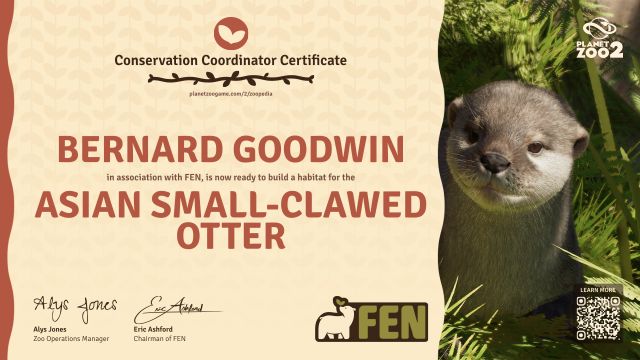
Prove your knowledge and create a personalised certificate endorsed by the Fauna & Ecosystems Network for the Asian Small-Clawed Otter.
Planet Zoo 2 is in active development and the Zoopedia reflects this work in progress. Text, images, stats etc. are not necessarily final and may change or be expanded upon.







 Bamboo Feeder
 Block of Frozen Fish
 Dog Ball
 Tennis Ball
 Cardboard Box
 Submarine Buoy
 Platform Floats
 Sprinkler
 Water Hoop